
Do you run out of go-power in the middle of the morning? Maybe you find it hard to focus and your ability to call on your memory is strained. Or perhaps you suffer from an after-lunch slump. Some people find that their brain fog is troublesome most of the time. While there are some medical conditions that produce brain fog, you just might find that changing what you eat could help your mental clarity and reduce brain fog.
At The People’s Pharmacy, we strive to bring you up‑to‑date, rigorously researched insights and conversations about health, medicine, wellness and health policies and health systems. While these conversations intend to offer insight and perspective, the content is provided solely for informational and educational purposes. Please consult your healthcare provider before making any changes to your medical care or treatment.
How You Can Listen
You could listen through your local public radio station or get the live stream at 7 am EST on Saturday, October 17, 2026, through your computer or smart phone (wvtf.org). Here is a link so you can find which stations carry our broadcast. If you can’t listen to the broadcast, you may wish to hear the podcast later. You can subscribe through your favorite podcast provider, download the mp3 using the link at the bottom of the page, or listen to the stream on this post starting on Oct. 19, 2026.
How Could Eating Better Reduce Brain Fog?
Our guest, Dr. Uma Naidoo, is a leader in nutritional psychiatry. She found in her practice that what people eat can make a big difference for their mood and even their cognition. Breakfasting on coffee and donuts is often a preamble to needing (not just wanting) a coffee break mid-morning. Evidence has been growing that people may perform differently depending on the type of breakfast that they had. This could well vary from one person to the next. Some thrive on a bowl of steel cut oats with yogurt and berries, while others notice that it doesn’t carry them through the morning. Dr. Naidoo suggests that in most cases a low-carb breakfast with plenty of protein will serve us better than the typical Danish and coffee.
The Impact of Sugar on Cognitive Health
A fascinating study published earlier this year demonstrated the surprisingly persistent effects of consuming sugar. The investigators took advantage of a natural experiment occasioned by the rationing of sugar during and after World War II (NPJ Aging, July 22, 2026). They compared people born between 1951 and 1956. Some of these were exposed to sugar rationing only while in utero, some were exposed to it in utero and up to age two, while the third group was conceived and born after sugar rationing had stopped.
Those babies are now in their 70s. Those with their first thousand days under sugar rationing have dramatically lower risk for developing dementia–a 27% lower risk for any type of dementia and a 46% lower risk for Alzheimer disease. We don’t have any studies showing that limiting sugar in adulthood can benefit the brain in the same way, but the evidence we do have suggests eating less sugar might reduce brain fog.
Is Your Medicine Causing Brain Fog?
When psychiatrists prescribe pills to treat depression, anxiety or other mental illnesses, they are aware that one of the effects might be confusion or lack of mental clarity. These are not the only types of medication that can cause trouble, though. Many people rely on over-the-counter sleep aids night after night. Nearly all of these contain diphenhydramine (DPH) as their active ingredient.
DPH counteracts the activity of a neurotransmitter called acetylcholine. As a result, pharmacologists classify it as an “anticholinergic” drug. Even by itself, but certainly in combination with other anticholinergic medicines, DPH can lead to brain fog. If you are interested in exploring what those other anticholinergic drugs are, you will find a list here.
The Insomniac’s Dilemma
Many people who frequently have trouble sleeping feel like they’ve been put between a rock and a hard place. To function at their best, they need adequate sleep. But the sleeping meds they rely on, whether they contain DPH or a Z drug like zaleplon (Lunesta), zolpidem (Ambien) or eszopiclone (Sonata), may lead to next-day fuzziness or eventually chronic brain fog. When possible, lifestyle measures such as early-morning light exposure, vigorous exercise during the day and avoiding caffeine after midday might help a person avoid this difficult dilemma.
What Diet Is Best to Reduce Brain Fog?
If you want to improve your mood and mental alertness, what diet should you choose? Recently, we spoke with a nutritional psychiatrist who is enthusiastic about a ketogenic diet for treating anxiety or depression. Dr. Naidoo says a thoughtful approach can allow for a keto diet, or a paleo diet, a vegetarian diet or a vegan diet. The keto diet can be effective, but it requires a great deal of attentive management, which may be just too much for some patients.
It is very important that the diet be based on whole foods rather than highly processed foods. It should also be tailored to the individual’s cultural preferences. Doctors often recommend a Mediterranean diet because so much evidence points to its benefits. But other diets, such as a Nordic diet (in Scandinavia) or a North Indian diet (in Punjab, for example), can also be healthful within a cultural context (Journal of Clinical Lipidology, Nov-Dec. 2025).
Do Hormones Affect Brain Fog?
Many people are convinced that hormonal changes can contribute to brain fog. Some women find their focus shifts throughout the menstrual cycle. Others report increased brain fog as one of the troublesome symptoms of menopause. People who have experienced thyroid hormone imbalances have noted that their attention and alertness is diminished until balance is restored.
Favorite Foods from our Guest
We asked Dr. Naidoo about her favorite recipes. As a chef, she is very fond of the French tradition. She also loves the Indian foods she grew up with. One of her favorites is chicken tikka masala. Substituting tofu for the chicken produces a delicious vegetarian dish. She also recommended miso-glazed sweet potatoes and a kaleidoscope salad with multi-colored veggies. For dessert, she suggests an avocado-cacao mousse.
Utilizing Food as Medicine
Dr. Naidoo points out that the gut microbes begin to respond to dietary changes within 24 hours. However, it could take a week or more–up to a month–for a person to notice differences in how they are feeling. Some of her colleagues are quite interested in the opportunities to utilize natural approaches along with or in place of conventional medications. The theme of the 2025 annual meeting of the American Psychiatric Association was “Lifestyle for Positive Physical and Mental Health.” Moreover, Harvard Medical School is in the process of integrating lifestyle psychiatry into its curriculum, so future healthcare professionals are likely to be more open to this approach.
This Week’s Guest
Uma Naidoo, MD, is the founding director of the first hospital-based Nutritional Psychiatry Service in the United States. She is the Director of Nutritional, Lifestyle and Metabolic Psychiatry at Massachusetts General Hospital while serving on the faculty at Harvard Medical School.
Dr. Naidoo is also a professional chef, graduating from the Cambridge School of Culinary Arts and receiving the school’s most coveted award, the MFK Fisher Award for Innovation. She is the author of This Is Your Brain on Food and Calm Your Mind with Food. Dr. Naidoo’s new book, The Mental Clarity Diet: Sharpen Your Focus, Lift Your Mood, and Protect Your Memory with Food will be released in March 2027. Her website is: https://umanaidoomd.com/
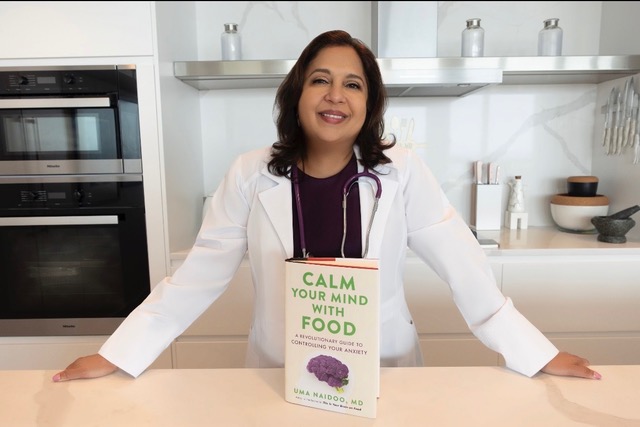
Dr. Uma Naidoo, Massachusetts General Hospital
Listen to the Podcast
The podcast of this program will be available Monday, October 19, 2026, after broadcast on Oct. 17. You can stream the show from this site and download the podcast for free.
Citations
- Lian X et al, "Early-life sugar rationing, brain aging, and long-term neurodegenerative and psychiatric health outcomes: a population-based natural experiment study." NPJ Aging, July 22, 2026. DOI: 10.1038/s41514-026-00452-z
- Singh A et al, "An Indian adapted Mediterranean diet: A feasibility study." Journal of Clinical Lipidology, Nov-Dec. 2025. DOI: 10.1016/j.jacl.2025.08.013