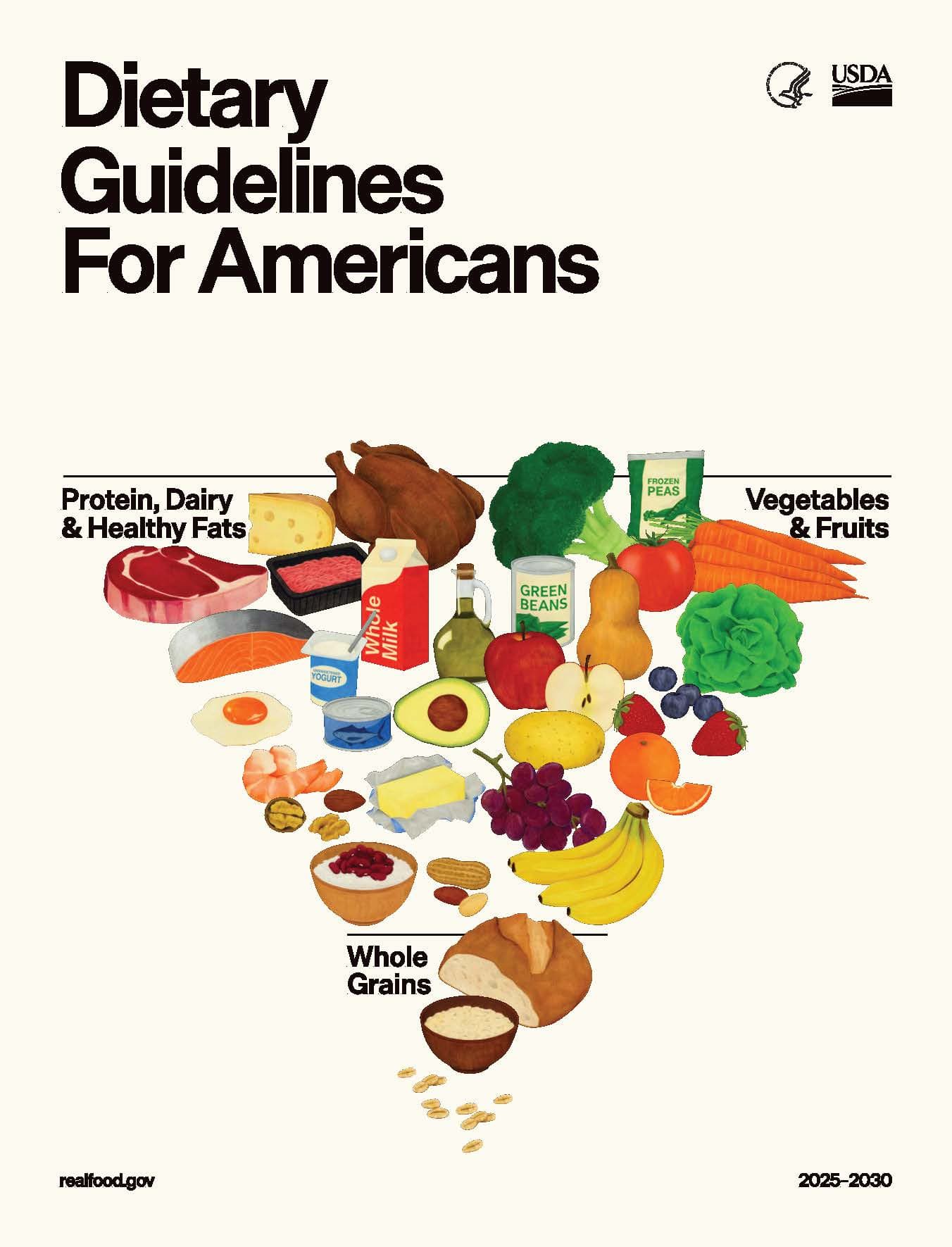
If you aren’t bewildered, perhaps even exasperated, by the constant contradictions in nutrition advice, we would be astonished. People often assume the experts know for certain, but doctors, dietitians and nutrition experts are just as challenged by uncertainty as the rest of us. And now, on January 7, 2026, Health and Human Services (HHS) Secretary Robert F. Kennedy, Jr., has announced new dietary guidelines. Mr. Kennedy states that: “Protein and healthy fats are essential and were wrongly discouraged in prior dietary guidelines. We are ending the war on saturated fat.” This flip-flop on saturated fat will likely drive a lot of dietitians, nutrition experts and cardiologists up the wall.
The new food pyramid has been turned upside down. It will put a priority on fruits, vegetables, red meat and full-fat dairy. Forget the skim milk, low-fat yogurt or fat-free cheese. The new food pyramid encourages foods that were once either forbidden or highly restricted. Avocados are in, along with walnuts and steak. Out are highly-processed foods, sugar-sweetened soft drinks and refined carbohydrates. The new guidelines represent the greatest change in dietary recommendations from federal authorities in decades.
Understanding the Flip-Flop on Saturated Fat:
For decades, Americans have been warned—often emphatically—to avoid saturated fat. This advice was grounded in a seemingly simple theory: saturated fat raises cholesterol; cholesterol clogs arteries; clogged arteries cause heart attacks. That framework shaped nutrition policy, medical education and grocery store shelves for more than half a century.
What has changed in 2026 is not that new science suddenly appeared overnight. What changed is that federal policy makers are now publicly acknowledging how shaky that old foundation has been all along.
The American Heart Association (AHA) has long maintained that saturated fats raise LDL (“bad”) cholesterol and therefore increase the risk of heart attack and stroke. On that basis, Americans were urged to abandon eggs, switch to skim milk, trade butter for margarine, choose low-fat yogurt, avoid red meat and shun full-fat cheese. These changes were widely applauded by nutrition experts.
But here’s the uncomfortable question—one that the new dietary guidelines implicitly force back into the spotlight:
Did any of this actually reduce heart attacks or deaths from heart disease?
The persistence of heart disease despite strict adherence to low-fat advice is one reason the new federal guidelines have landed with such controversy.
Read more about that paradox at this link:
If Statins Save Lives, Why Is Heart Disease Still #1 Killer?
Heart disease remains our # 1 killer, even after decades of statin therapy. Why don’t statins save lives when it comes to primary prevention?
RFK, Jr., Creates Confusion:
In early 2025, RFK, Jr., encouraged Americans to embrace “real foods.”
That was a message that resonated with many people who are weary of ultra-processed foods. The “Make America Healthy Again” movement has gone after artificial food dyes. We cannot argue with that. In fact, we have written about it in this article. Getting rid of Red Dye No. 3 from foods and drinks seems to us to be a very good idea.
Kennedy has also targeted ultra-processed foods, arguing that they contribute to the epidemic of chronic disease in the U.S. and that they are, quite literally, “poisoning” people. On this point, he is hardly alone. Many of the experts we have interviewed on our nationally syndicated radio show agree that highly-processed foods are a major driver of metabolic illness worldwide.
Where Kennedy parts ways most dramatically with the nutrition establishment is his insistence that Americans should no longer fear meat and full-fat dairy. Butter, milk, yogurt and cheese, he argues, are real foods that were unfairly demonized.
That position has left many dietitians, cardiologists and public health professionals deeply unsettled, especially now that it has been codified in the 2026 dietary guidelines.
Cholesterol in Eggs? The Controversy Refuses to Die
Doctors and nutrition professionals, like everyone else, are challenged by uncertainty. Medical students learn what they are taught—and for generations, dietary cholesterol was presented as settled science.
Eggs Were Exhibit A:
For decades, the accepted wisdom was that eating cholesterol-rich foods such as eggs would raise blood cholesterol and increase heart disease risk. The American Heart Association (AHA) once advised limiting eggs to no more than three per week.
That guidance quietly softened over time. By 2002, restrictions were eased, and by 2013 the AHA conceded that a low-cholesterol diet might not meaningfully reduce LDL cholesterol at all.
Since then, most studies have failed to find a clear link between egg consumption and clogged arteries.
A review (Current Atherosclerosis Reports, July 2023) notes:
“A meta-analysis of 39 observational studies including nearly 2 million individuals found no association between the highest intake of eggs and CVD [cardiovascular disease] mortality, and similar findings were presented in another meta-analysis of 24 observational studies of over 11 million individuals that found no association between highest intake of eggs and CVD mortality.”
But wait, if you think that concludes the controversy, the same authors conclude that the egg question remains unsettled. Their summary states:
“Recent findings are inconsistent regarding the possible relationship between egg consumption and CVD mortality and morbidity.”
If that feels unsatisfying, consider one of the most provocative experiments ever conducted on dietary cholesterol. Nick Norwitz, MD, PhD, consumed 24 eggs a day for 30 days—a total of 720 eggs and 133,200 mg of cholesterol.
The result? His total cholesterol dropped 2%, and his LDL fell by 18%.
You can read all the details at this link:
Egg Experiment Reveals Eating Eggs Lowers LDL Cholesterol!
Data like these don’t just challenge old beliefs—they expose how fragile those beliefs were to begin with. The same can be said of other dietary dogmas.

A variety of dairy products including cheese, milk and yogurt.
Sat Fat Is Sinful…or Is There a Flip-Flop on Saturated Fat?
Even as egg phobia has faded, saturated fat has remained the nutrition world’s untouchable third rail. Whole milk, butter and cheese are still widely portrayed as cardiovascular threats.
The American Heart Association (AHA) continues to advise substituting fat-free milk and low-fat dairy for full-fat versions. Yet research has been quietly undermining this position for years.
It remains an article of faith. Most Americans believe this and are careful to avoid whole milk and other full-fat dairy products. The AHA warns on its website to substitute fat-free (skim or “light”) milk and low-fat yogurt or cheese. Research, however, contradicts the AHA (American Journal of Clinical Nutrition, Sept. 2021).
Saturated Fat: Villain, Scapegoat or Red Herring?:
A randomized controlled trial compared consumption of low-fat and high-fat dairy products over 12 weeks (American Journal of Clinical Nutrition, Sept. 2021). The control group limited their intake of dairy products.
All of the participants in this trial had metabolic syndrome. This constellation of high blood sugar, elevated cholesterol, hypertension and a large waist puts people at high risk for heart disease and diabetes. These are considered prime candidates for heart attacks, so they are the perfect subjects for this controlled trial.
Cardiologists might be surprised by the results of this study because they contradict conventional wisdom. There were no differences between groups with respect to LDL, HDL or total cholesterol, triglycerides or free fatty acids.
Please hit the pause button in your brain. Let the words percolate through your synapses.
Better yet, read the authors’ observations in their own words:
“In this 12-wk RCT [randomized controlled trial] in individuals with MetS [metabolic syndrome], consuming 3.3 servings of full-fat dairy/d in the form of milk, yogurt, and cheese did not significantly affect the fasting lipid profile compared with consuming identical amounts of low-fat dairy or a diet limited in dairy. This included no significant difference in the cholesterol content of any of the 38 isolated plasma lipoprotein fractions, despite substantial differences between the 3 diets in the consumption of total fat and SFAs [saturated fatty acids].
“The results of this study challenge the hypothesis that consuming full-fat dairy products increases the risk of CVD through elevating total and LDL-cholesterol concentrations, as a result of their high SFA and cholesterol content.”
The researchers conclude:
“In men and women with metabolic syndrome, a diet rich in full-fat dairy had no effects on fasting lipid profile or blood pressure compared with diets limited in dairy or rich in low-fat dairy. Therefore, dairy fat, when consumed as part of complex whole foods, does not adversely impact these classic CVD [cardiovascular disease] risk factors.”
Another Flip-Flop on Saturated Fat:
If all of this sounds familiar, that’s because it isn’t new science. As far back as 2014, researchers reviewing data from over 600,000 people (Annals of Internal Medicine (March 18, 2014) found no convincing evidence that saturated fat consumption increases heart disease risk.
More unsettling still, some saturated fats associated with dairy appeared to have an inverse relationship with coronary disease—meaning higher intake was linked to lower risk.
What did stand out as dangerous? Trans fats.
The same fats once promoted in margarine as a heart-healthy alternative to butter.
That historical irony has not aged well.
The researchers also noted that polyunsaturated fats low in cholesterol such as corn or safflower oil do not appear to protect people from heart attacks. This too contradicts the nutritional principles that have reigned in the U.S. for decades. This is all quite heretical.
The Flip-Flop on Saturated Fat Disappeared Without a Trace:
Here are the conclusions of the study in the Annals of Internal Medicine:
“In conclusion, the pattern of findings from this analysis did not yield clearly supportive evidence for current cardiovascular guidelines that encourage high consumption of polyunsaturated fatty acids and low consumption of saturated fats.”
Lest you think the Annals of Internal Medicine is some wackadoodle medical journal that is easily ignored, please reconsider. This publication was established in 1927 and is one of the premier journals in American medicine. It is published by the American College of Physicians (ACP) and according to Wikipedia is:
“…one of the most widely cited and influential specialty medical journals in the world.”
Why the New 2026 Guidelines Matter:
What makes today different is not the evidence—it’s the acknowledgment.
For years, studies like the Sydney Diet Heart Study and the Minnesota Coronary Experiment sat quietly in the background, their inconvenient findings largely ignored. Both showed that replacing saturated fat with polyunsaturated vegetable oils lowered cholesterol—but did not reduce deaths from heart disease.
Now, in 2026, federal dietary policy has finally caught up with decades of uncomfortable data.
Whether the nutrition establishment follows remains to be seen.
The Sydney Heart Study:
Please note the dates. They are crucial! The Sydney Diet Heart Study ran between 1966 and 1973 in Australia. The results weren’t published for 40 years (BMJ, Feb. 5, 2013).
The researchers in this experiment assigned high-risk men to use either margarine or butter during that time. Men using safflower oil margarine were 60 percent more likely to die over the years of the study. The absolute risk of death from heart disease went from 10 percent on the butter-rich diet to 16.3 percent on the margarine-based diet.
The Minnesota Coronary Experiment:
Another trial pitting butter against margarine ran about the same time. The Minnesota Coronary Experiment involved more than 9,000 patients in mental institutions and a nursing home. The researchers had total control over the subjects’ diets. The test diets included one high in saturated fat and the other high in polyunsaturated fats from corn oil.
Like the Sydney Diet Heart Study, the results were not what the investigators expected. Perhaps that explains why the data were not published until much later (Atherosclerosis, Jan-Feb. 1989). Patients on the corn oil diet had less cholesterol in their blood, but they were just as likely to die from heart disease.
What About Saturated Fat in Meat?
Here are more analyses published in the highly regarded Annals of Internal Medicine (Oct. 1, 2019). Get the straight and skinny on this research in our overview at this link.
The French never bought the American prohibition on saturated fat. They were loathe to give up their Brie, Camembert, paté, boeuf bourguignon and chocolate soufflé. Cardiologists were puzzled by the “French paradox.” Despite such foods rich in saturated fat, French heart attack rates have been considerably lower than those in the U.S.
If there is a moral to this ongoing diet controversy, it is that high-fat dairy products do not appear to be as dangerous as doctors once thought. Despite the latest study and all the others that have gone before it, we do not expect the AHA or nutrition experts to change their thinking.
In recent years we have seen the pillars of dietary dogma collapsing. Here is a list:
Eggs:
Before, cholesterol-laden yolks were thought to clog your arteries and lead to heart disease.
Now, eggs are considered an excellent source of high-quality protein.
Coconuts and avocados:
Before, these foods were off limits because of high saturated fat content.
Now, they are considered OK with potential health benefits.
Nuts:
Before, these were high fat treats, thought to raise cholesterol, heart attack risk and cause weight gain.
Now, nuts are known to contain good fats and data prove people who eat nuts lower their risk of heart attacks!
Shrimp:
Before, shrimp were believed to be sinful, high in cholesterol and dangerous for those at risk of heart disease.
Now, they are considered a good source of protein and raise good HDL cholesterol.
Butter:
Before, butter was a no-no because it is high in sat fat and cholesterol.
Now, butter is better than margarine made from trans fats.
Salt:
Before, salt was bad, raising blood pressure and causing heart disease.
Now, data indicate that there is a sweet spot. Going too low on sodium increases the risk of death!
Coffee:
Before, people were told to lay off the java because it raises blood pressure and harms the heart.
Now, coffee is a known source of dietary antioxidants. It helps prevent diabetes and may partially protect against neurological diseases like Parkinson’s and dementia.
Chocolate:
Before, chocolate was frowned upon as fattening and bad for the skin. It was also viewed as contributing to indigestion and reflux by relaxing the lower esophageal sphincter. Chocolate was featured on many lists of foods that people prone to migraine should avoid.
Now, chocolate with more cocoa flavanols than sugar is known to relax blood vessels and lower blood pressure. It may help maintain good cognitive function and reduce the risks of stroke and heart attack. While some individuals may find that chocolate triggers reflux or a migraine, most people handle it without difficulty.
Whole Milk, Cream & High-Fat Yogurt:
Before, high-fat dairy foods were believed to contribute to heart disease and obesity.
Now, studies show that both kids and adults who consume high-fat dairy are actually skinnier than those who consume skim milk and low-fat dairy products. The new research (above) shows that saturated fat found in high-fat dairy does not cause heart disease.
The Bottom Line on Saturated Fat:
What are we to make of all the food confusion? If there is a take-home message from all this, it is that evidence trumps belief. For decades “experts” have made assumptions about various foods. Because egg yolks contained cholesterol, they decided that eggs caused heart disease, without any data to support that hypothesis.
When research actually revealed that eggs do not cause heart disease, there has been a begrudging retreat from the hard line advice to shun eggs. But old ideas die hard. There are still many health professionals who caution against eating foods like eggs, avocados, nuts and shrimp, despite data to the contrary.
What About Dairy Products?
We suspect that the evidence that full-fat dairy products don’t raise cholesterol in high-risk patients will be challenging for most health professionals to accept. After all, it contradicts everything we have been told about a heart-healthy diet for more than 50 years.
Accepting the data (American Journal of Clinical Nutrition, Sept. 2021) and the analysis of 72 studies involving more than 600,000 people would mean that our thought leaders and policy makers got it wrong. In such scenarios, many people would prefer to shoot the messengers and pretend that the data do not exist. The research is likely to disappear without a trace and some nutrition experts will pretend it never saw the light of day.
In case you think this is old news, a study published in the journal BMC Cardiovascular Disorders (July 21, 2023) comes to a similar conclusions.
The authors introduce their study with this statement:
“The role of fatty acids in coronary heart disease (CHD) remains uncertain. There is little evidence from large-scale epidemiological studies on the relevance of circulating fatty acids levels to CHD risk.”
The researchers examined data from roughly 90,000 participants in the UK Biobank. Blood lipids were measured and people were followed for about 12 years. High triglyceride levels were the bad actors rather than saturated fatty acids. What raises triglycerides? A diet that high in ultra-processed foods is a major culprit. That means simple carbohydrates and sugar! Fiber-rich foods lower triglyceride levels.
The 2025 Flip-Flop on Saturated Fat Gets More Dramatic:
Fast forward to 2025, and the scientific controversy has intensified. A comprehensive systematic review and meta-analysis published in the JMA Journal (April 28, 2025) examined nine randomized controlled trials involving 13,532 participants. The conclusion was stunning:
“The findings indicate that a reduction in saturated fats cannot be recommended at present to prevent cardiovascular diseases and mortality.”
The authors go on to state:
“In the present meta-analysis, we found no statistically significant evidence supporting CVD [cardiovascular disease] prevention through SFA [saturated fatty acid] reduction.”
Most physicians believe that they are practicing “evidence-based medicine” when they recommend restrictions on foods containing saturated fat. If one were to believe the most recent meta-analysis cited above, you would have to conclude that the evidence is lacking.
Real Food:
What should you do? We follow the advice of Robert Lustig, MD, author of the book Fat Chance: Beating the Odds Against Sugar, Processed Food, Obesity, and Disease and Michael Pollen, author of In Defense of Food, An Eater’s Manifesto. They make it very clear: “EAT REAL FOOD!”
If it comes in a package with a long list of unpronounceable chemical ingredients, think twice or three times! Grandmothers instinctively knew that food grown in the garden and prepared with love was better than anything produced in a factory. Joe’s mother always believed butter was better than margarine and it turns out she was right.
Your Opinion:
What do you think? We would love to get your response to this essay. How do you deal with the food flip-flops of the last several years regarding nuts, chocolate, coffee and coconut? What do you make of the saturated fat controversy? Share your comments below.
If you agree with the mantra to “Eat Real Food!” you may find our books, Recipes and Remedies from The People’s Pharmacy and Spice Up Your Health: How Everyday Kitchen Herbs &Spices Can Lengthen & Strengthen Your Life worth checking out. Here are links to all our publications.
If you think this article was worthwhile, please share it with friends and family. We have tried to make it easy. If you scroll to the top of the page you will see icons for email, and social media. Why not send it to those you care about and support our work at the same time. If you appreciate our perspective, you can contribute by going ad free when you browse our website. Here is a link to show you how. Or, you could make a one-time donation at this link. Thank you so much for supporting our work.
Citations
- Jin, D., et al, "Associations of circulating fatty acids with incident coronary heart disease: a prospective study of 89,242 individuals in UK Biobank," BMC Cardiovascular Disorders, July 21, 2023, doi: 10.1186/s12872-023-03394-6
- Carter, S., et al, "Eggs and Cardiovascular Disease Risk: An Update of Recent Evidence," Current Atherosclerosis Reports," July, 2023, doi: 10.1007/s11883-023-01109-y
- Schmidt, K.A., et al, "Impact of low-fat and full-fat dairy foods on fasting lipid profile and blood pressure: exploratory endpoints of a randomized controlled trial," American Journal of Clinical Nutrition, Sept. 1, 2021, doi: 10.1093/ajcn/nqab131
- Mizuno, A., "There Is More Than Meets the Label: Rethinking Saturated Fat and Cardiovascular Health," JMA, April 4, 2025, doi: 10.31662/jmaj.2025-0120
- Yamada, S., et al, "Saturated Fat Restriction for Cardiovascular Disease Prevention: A Systematic Review and Meta-analysis of Randomized Controlled Trials," JMA Journal, April 28, 2025, doi: 10.31662/jmaj.2024-0324. Epub 2025 Mar 21