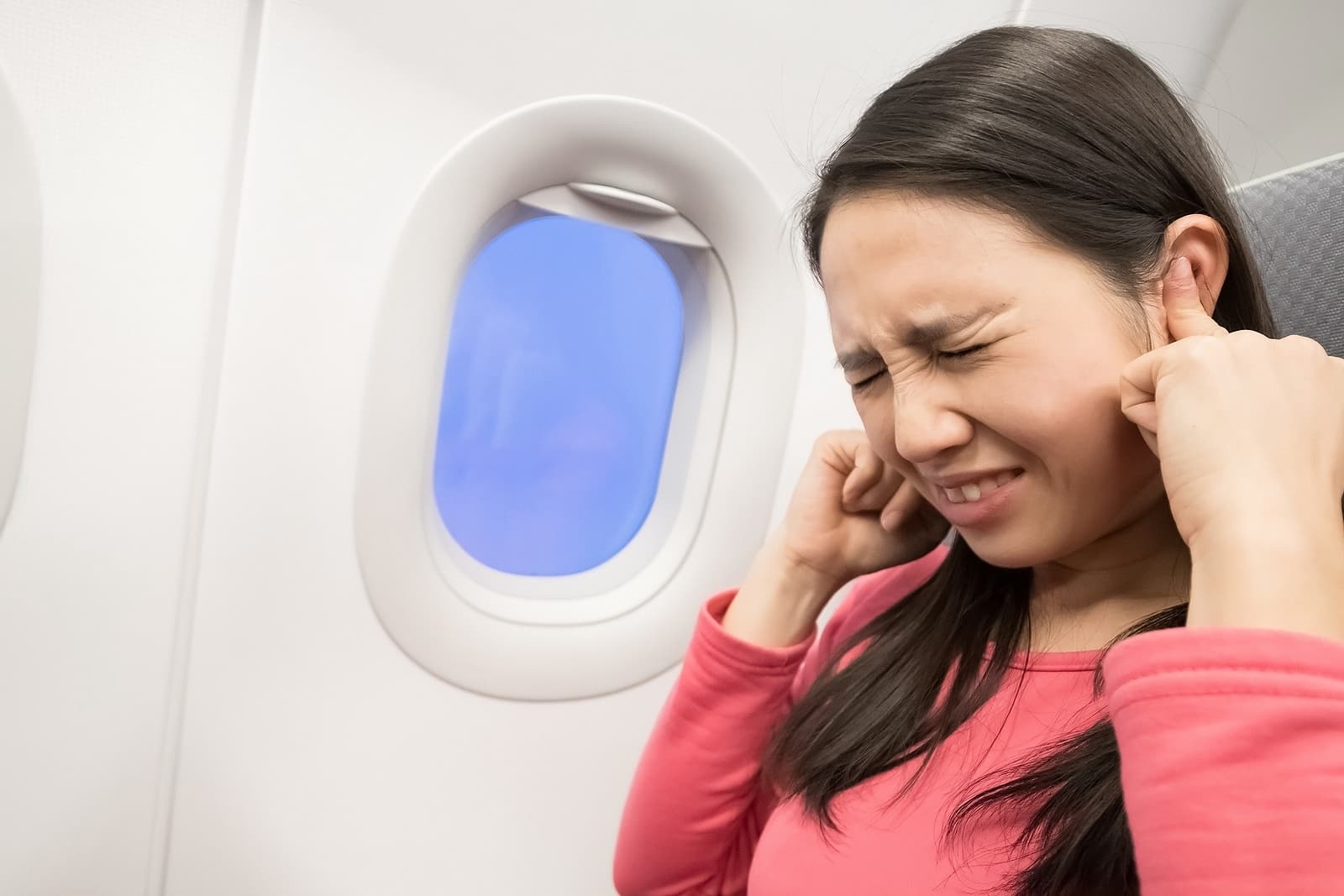
Around the holidays, we often hear from people who find flying challenging because of severe ear pain during flights. This can turn a European trip or even a visit to relatives across the country into agony. “Airplane ear” is known medically as barotitis media, aerotitis media or barotrauma. Have you ever experienced ear pain as the plane descends? What have you done about it?
When An Airplane Loses Altitude:
Many people experience airplane ear during descent. That’s because the pressure inside the ear is lower than the pressure in a rapidly descending airplane. As pressure increases in the cabin, it pushes on the eardrum which in turn pushes towards the middle ear where air pressure is lower.
Symptoms can start as fullness in one or both ears. There can be mild discomfort, moderate pain or a really unbearable sensation that may be accompanied by hearing loss, dizziness or ringing in the ears (tinnitus).
The eustachian tube is the great equalizer. It helps regulate pressure between the middle ear and outside world. This passageway connects the middle ear to the nose and throat. Anything that blocks the eustachian tube can make it hard to equalize the pressure in the middle ear. That includes allergies, a cold, sinusitis or a middle ear infection.
Fortunately, there are several ways to avoid ear pain during flights, especially during descent.
Temporary Use of Afrin (oxymetazoline) nasal Spray:
Q. I dread flying if my allergies are active, as my ears hurt when we get ready to land. If I must fly during allergy season, I take a decongestant and use a long-lasting spray like Afrin before the flight. During the descent, yawning with my mouth closed, like trying to stifle a yawn, helps relieve the ear pressure.
The spray works wonders, but I have to be careful to use it only for a short time. Otherwise, rebound congestion is a big problem.
A. When you are congested, the eustachian tube connecting the middle ear to the nose and throat becomes blocked. This tube equalizes pressure between the atmosphere and the middle ear.
When a plane descends, cabin pressure changes rapidly. That can cause ear pain if the eustachian tube isn’t open. Swallowing or yawning helps. So does chewing gum. As you have discovered, a decongestant can also be helpful, but should only be used for a few days.
Temporary Use of Sudafed (Pseudoephedrine):
This reader has a somewhat similar solution:
Q. I read a question from a reader experiencing ear pain when flying. My solution for flights is to take a Sudafed three hours before landing.
The decongestion medicine seems to open my sinuses, and I land without any pain in my ears.
A. Pseudoephedrine (Sudafed) is an oral decongestant that can open nasal passages. Since ear pain upon descent is related to changes in air pressure, it is not surprising that this medication could help. It is only available behind the counter, though, so people will have to ask the pharmacist for it. A number of people cannot tolerate the drug because of high blood pressure or an enlarged prostate. Always check the label to see if it is safe for you.
Other Ways to Prevent with Ear Pain During Flights:
This reader has had good experience with a rather complex regimen.
Q. I have read questions about painful ears during flights. This was a severe problem for me.
An ENT Doctor’s Recommendation for Ear Pain During Flights
I now follow this regimen an ENT doctor gave me and it works. Ten days before flying I start using Nasacort nasal spray twice a day. I take Benadryl an hour before the flight and use Afrin spray 30 minutes before taking off (2 sprays per nostril).
I also use EarPlanes ear plugs and chew gum during the flight. I use Afrin spray (2 squirts in each nostril) when the pilot announces that we will be landing (or 20 minutes before landing).
This is a lot of stuff, but it has kept me traveling. Without it, I’d have to stay home.
A. Wow! That is an impressive treatment program. Others may benefit.
Some folks may not be familiar with EarPlanes ear plugs, which are designed expressly for this purpose. They are silicone earplugs with a special pressure-regulating filter to moderate the rapid increase in pressure as the plane descends. They can be purchased in airport stores and online.
Leslie said:
“I used EarPlanes after a bout with vertigo that made me very nervous about a cross-country flight. They weren’t super-comfortable, but they worked really well. I didn’t have any of the usual pressure and ear-popping that I normally associate with flying.”
Please share your own strategy for dealing with ear pain during flights in the comment section below. You can read much more about EarPlanes and a hot home remedy at this link.
Citations
- Bhattacharya, S., et al, "'“Airplane ear'—A neglected yet preventable problem," AIMS Public Health, Aug. 26, 2019, doi: 10.3934/publichealth.2019.3.320