
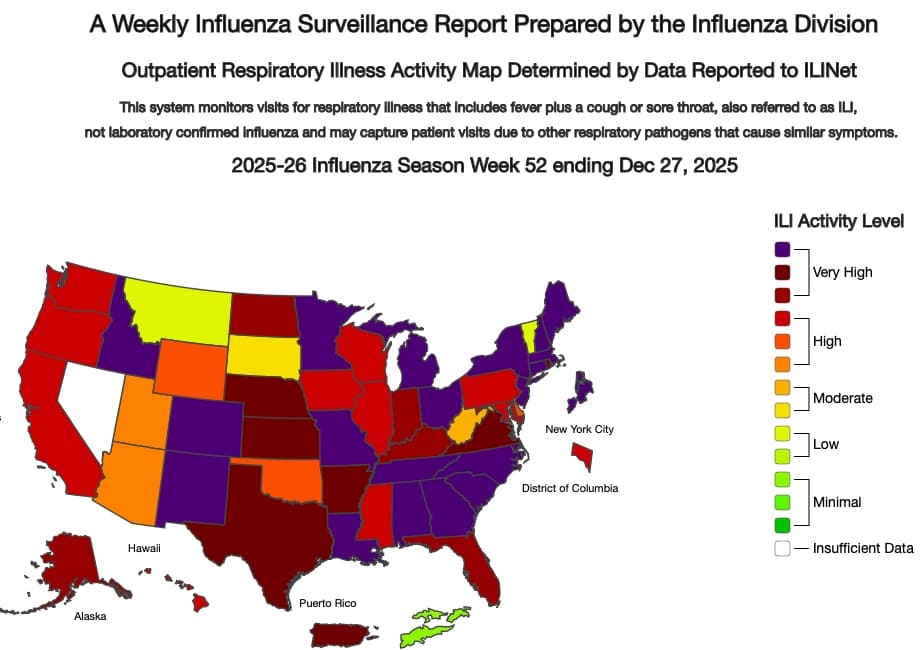
There’s no gentle way to say this anymore: the United States is in the early stages of an influenza epidemic. Flu activity isn’t just “high” or “surging.” It has blown past the epidemic threshold — early, fast, and harder than we’ve seen in decades. Yet most public health messaging still tiptoes around the obvious, relying on euphemisms instead of plain language. As far as we can tell, neither the CDC nor the World Health Organization (WHO) have used the terms “influenza epidemic” or “pandemic.” Why not? Should they?
Influenza-like illness — the combination of fever, cough, and sore throat that sends people to clinics and emergency rooms — is now higher than at any point in recent memory. More than half the country is reporting very high levels of illness, and the curve is still climbing. This is not a localized outbreak. It’s not a seasonal blip. It’s widespread, accelerating, and overwhelming health systems in multiple states.
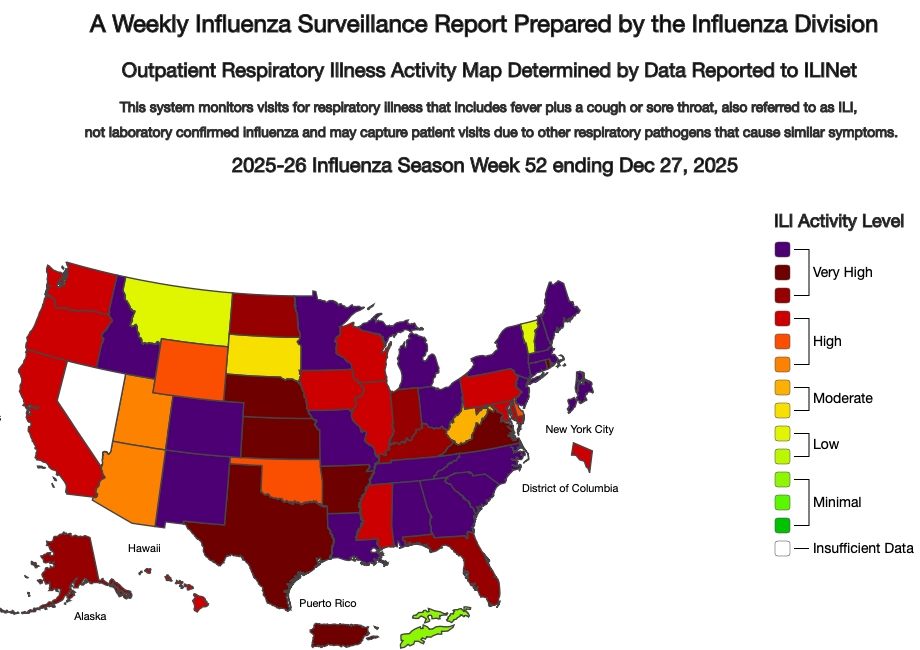
FluView from the CDC on 12-27-25
Headlines From Around the Country = Influenza Epidemic!
Look at the data on the most recent CDC map: December 27, 2025. That was two weeks ago. And the data that was used to create that map was already old when it was converted into a map. Based on subsequent reports and local data, I suspect that every state in the U.S. is now reporting “high” or “very high” flu activity. In fact, I believe this could turn into the worst influenza outbreak in recent memory.
I like to track local headlines around the country to get some sense about what’s happening on the ground. Here is what I have gleaned:
The video quotes a physician who reports that the fevers are higher, don’t respond to treatment as expected and are accompanied by a really bad cough, joint and muscle aches. Kids may experience vomiting and diarrhea.
“Austin Public Health officials warn flu cases are ‘increasing dramatically’ across central Texas, as seasonal flu activity continues to surge across the country.”
“Flu cases are surging in Michigan, state health experts say, as the flu season has hit harder and earlier than when it typically does, say some.”
“At least 45 states are reporting ‘high’ or ‘very high’ influenza activity, and doctors’ visits for flu-like symptoms have reached the highest level in more than 25 years, according to new data from the U.S. Centers for Disease Control and Prevention.”
“New York is seeing a record number of hospitalizations from the flu, and it could get worse.”
Why Are Public Health Officials Surprised By This Influenza Epidemic?
What makes this flu season especially troubling is that none of this should be a surprise. Six months ago, countries in the Southern Hemisphere experienced the same explosive pattern — a fast rise, heavy hospitalizations, and prolonged strain on the health system. That was before the mutated H3N2 Subclade K strain—sometimes referred to in the media as a “Super Flu”—took hold. The warning signals went largely unheeded. Now the United States is replaying the same script, only with more people vulnerable after years of disrupted immunity and uneven vaccine protection.
According to CDC estimates published on Jan. 5, 2026, influenza has already caused roughly 11 million illnesses, 120,000 hospitalizations, and 5,000 deaths this season — and we are nowhere near done. States like New York, Colorado, and Massachusetts are seeing record-breaking hospital admissions, driven largely by a mutated influenza A (H3N2) strain that changed after this year’s vaccine formula was locked in. The result? Partial protection, bad timing, and a flu season that is hitting harder than predicted.
Influenza Epidemic: The Words No One Is Saying (But Should)
Japan declared an influenza epidemic on October 3, 2025, closing schools and daycare centers as cases surged. In the United States, by contrast, officials continue to avoid the term — even as flu activity remains high or very high in nearly every region and cases have yet to peak.
Whether or not the World Health Organization ultimately applies the word pandemic, the reality on the ground is unmistakable: this is no longer just a bad flu season. When an illness spreads this widely, this rapidly, and this predictably, it deserves to be called what it is: an influenza epidemic in various countries–and arguably a pandemic by any common-sense definition. Whatever public health authorities choose to call this year’s influenza outbreak, it demands attention and action!
Actually, our health care system should have been preparing for this outcome months ago. It was highly predictable. I wrote an article about Japan’s influenza outbreak back in October:
An early and severe flu epidemic in Japan is closing schools and straining hospitals. It may foreshadow what’s ahead for the U.S.
On November 17, 2025 I wrote that we were:
Flying Blind into Influenza Season: Global Trends vs. CDC’s Lag
Has the CDC missed the early warning signs of influenza season? Australia and many other countries have had a bad flu season. Are we next?
I added more information to that post on December 2, 2025. But by then it was almost too late.
Are We Now In An Influenza Epidemic or Pandemic?
The CDC’s FluView from January 5, 2026 does not mention the word epidemic. It’s January 7 overview for the 2025-2026 Flu Season also avoids the word epidemic and insists that “The United States has not experienced an earlier start to its flu season.“
That might be technically true, but “Your Local Epidemiologist” provides a different perspective. She is Dr. Katelyn Jetelina, an assistant professor adjunct of epidemiology at the Yale School of Public Health. In her January 8, 2026 update, she shares a graph that shows us blowing past the “epidemic threshold.” And while the 2022-2023 flu season also hit early, we have zoomed past that year in total cases and we are substantially earlier than the bad 2024-2025 flu season.
Another epidemiologist we follow is Dr. Caitlin Rivers, Senior Scholar at the Johns Hopkins Center for Health Security and an Associate Professor in the Department of Environmental Health and Engineering at the Johns Hopkins Bloomberg School of Public Health. Her “Updated flu report, national edition” (January 7, 2026).
She reports:
“Flu season is in full swing, with outpatient influenza-like illness (ILI) reaching highs not seen in more than two decades.”
Health and Human Services (HHS) and the CDC may be reluctant to call this an influenza epidemic. And the World Health Organization (WHO) may be shy about calling what the world is facing an influenza pandemic, but here at the People’s Pharmacy we are not hesitant. We suspect that the 2025-2026 influenza season will turn out to be one of the worst on record once all the data are in.
Here is a list of countries that already had or are now experiencing widespread, early and intense flu activity:
- Australia
- New Zealand
- Japan
- Thailand
- United States
- United Kingdom
- Ireland
- France
- Germany
- Spain
- Romania
- Hungary
- Fiji
That’s just for starters. There are a lot of countries that we suspect are also experiencing an influenza surge, such as China.
Why is “Influenza Epidemic” Forbidden?
I understand why public health authorities around the world and in the United States are hesitant to use the “demic” word. No one wants to contemplate another epidemic or pandemic. The COVID-19 pandemic is still too fresh in our memories. But pretending this is just a “normal” flu season won’t make it go away any faster.
We are not suggesting this will be another 1918 flu pandemic. We hope that it will turn out to be milder and end sooner than current trends suggest. But we also hope that hospitals and public health agencies are prepared in case it continues to escalate.
Final Words:
We want to know what you’re seeing in your community. Please take a moment to provide a comment below. Has anyone you know come down with the flu? Please share any data you might have so we can report trends in coming days and weeks. That would include general location, what they had and how bad it might have been. We are hearing that this year’s influenza outbreak may last longer than usual. That’s based in part on the Australian experience.
You may want to listen to this week’s People’s Pharmacy radio show and podcast. It will air this Saturday morning (January 10, 2026) on many NPR stations. You can stream the show in real time by going to our host station, WUNC at 7:00 am and clicking on the live audio stream. A more civilized alternative would be to download the podcast from your favorite podcast provider, Apple Podcasts or directly from our Podcast Library come Monday morning.
Why should you listen to this Saturday’s radio show/podcast? Because we are interviewing a favorite People’s Pharmacy guest, Dr. Roger Seheult. He is an Associate Clinical Professor at the University of California, Riverside School of Medicine, and an Assistant Clinical Professor at the School of Medicine and Allied Health at Loma Linda University. Dr. Seheult is quadruple board-certified in Internal Medicine, Pulmonary Diseases, Critical Care Medicine, and Sleep Medicine through the American Board of Internal Medicine. Radio Show # 1457 is titled:
“How to Strengthen Your Immune System for Cold and Flu Season”
We think this science-based program with Dr. Seheult will be helpful when people are facing this year’s influenza epidemic. Please share this article with friends and family members who you think might benefit. We would be grateful if you could encourage them to sign up for our *FREE* newsletter so we can continue to bring you these updates. If you are fed up with ads on this website, you can go ad-free for the price of a monthly cup of coffee at this link. Thank you for supporting our work.
&description=Flu cases and hospitalizations are soaring nationwide as the U.S. crosses a critical threshold. Here’s why this INFLUENZA EPIDEMIC matters!&message=Flu Watch #4: This Is an INFLUENZA EPIDEMIC (Whether Officials Say So or Not)&redirect_asPath=https://www.peoplespharmacy.com/articles/flu-watch-4-this-is-an-influenza-epidemic-whether-officials-say-so-or-not)