Flip-Flops, Fungus and Foot Pain
Millions of people suffer with foot trouble. Some have heel pain when they first get out of bed. Others complain of flat feet or bunions. Athlete’s foot is very common, though it doesn’t always respond as expected to antifungal medications. Speaking of fungus, toenail fungus can be extremely stubborn. What are your feet trying to tell you about what they need? How can you keep them healthy, especially in the summertime?
At The People’s Pharmacy, we strive to bring you up to date, rigorously researched insights and conversations about health, medicine, wellness and health policies and health systems. While these conversations intend to offer insight and perspective, the content is provided solely for informational and educational purposes. Please consult your healthcare provider before making any changes to your medical care or treatment.
How You Can Listen
You could listen through your local public radio station or get the live stream at 7 am EST on Saturday, August 1, 2026, through your computer or smart phone (wunc.org). Here is a link so you can find which stations carry our broadcast. If you can’t listen to the broadcast, you may wish to hear the podcast later. You can subscribe through your favorite podcast provider, download the mp3 using the link at the bottom of the page, or listen to the stream on this post starting on August 3, 2026.
What Are Your Feet Trying to Tell You?
Most everyone looks forward to summer vacation, but that special time away from the usual routine may pose challenges for your feet. Whether you are hiking in the mountains or running on the beach, you may need to pay attention to your tootsies.
Time at the Beach
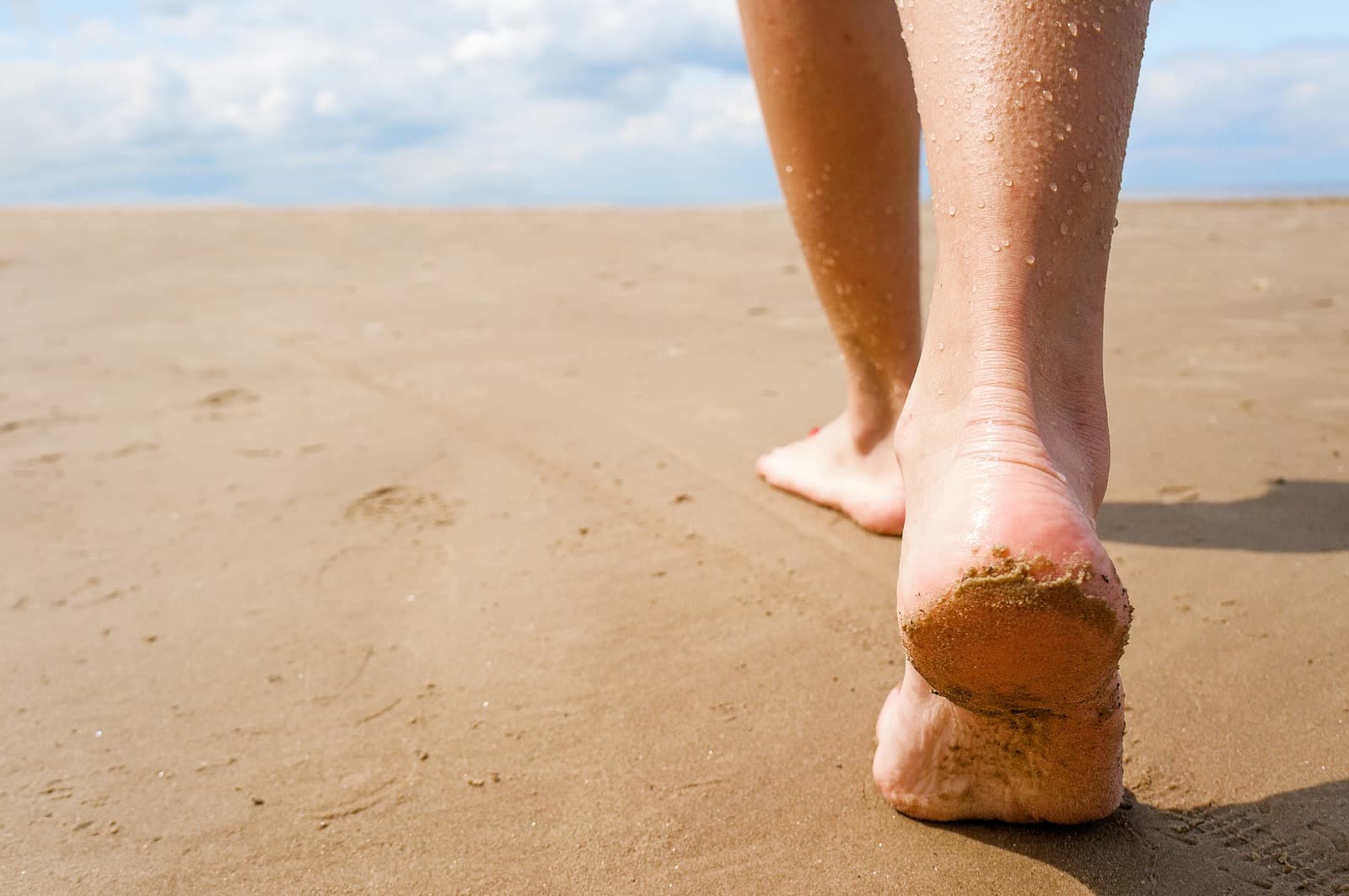
Beach time can inspire long walks on the sand, but soft sand could really put a strain on foot muscles that aren’t accustomed to it. Our expert guest, podiatrist Jane Andersen DPM, recommends wearing good running shoes for walking long distances on sand. Choosing to walk where the sand is hard-packed when the tide is low can also be helpful.
Possibly the most important but easily overlooked step to protect feet at the beach is to apply sunscreen. The tops of the feet are easily overlooked, but they can burn pretty readily. And if you are planning to spend time sunbathing prone, you might even want to apply sunscreen to the bottoms of your feet. They never see the sun, and walking on sunburned soles could be quite painful.
Protecting Bare Feet
Another consideration at the beach is how you will get from the parking lot or boardwalk to the water. How hot is the sand? If it is hot enough to burn the soles of your feet, you might consider using water sandals.
In general, going barefoot can be risky. Whether you’re at the beach, at a campground, in your own backyard or even inside your home, there are potential hazards underfoot. Bits of glass shards, little pieces of wire, tiny pebbles or nails could all cause havoc if they end up embedded in a sole. Protecting your soles by wearing good flip-flops makes a lot of sense. To find a list of flip-flops that provide appropriate arch support as well as sole protection, consult apma.org.
Treating Black Toenails
During this episode, Joe describes a trip to the beach with a long walk. By the time he removed his shoes, his longest toe had a black toenail that was rather painful. Although the pain faded before too long, it took about a year for the dark color to disappear from the nail. Dr. Andersen suggests that it often takes at least nine months to regrow a toenail. She emphasizes that if the nail turns black due to sudden trauma (like dropping something heavy on the toe), a podiatrist should check it out. Sometimes there is a fracture under that discolored nail that requires medical attention for proper healing.
What Is the Story on Flat Feet?
Joe has always had flat feet. Perhaps your feet are flat, too. The condition is pretty common. If Joe gets out of a bathtub or swimming pool and leaves footprints, they are almost oval. There is very little indentation in the center. Other people with higher arches may leave footprints that are nearly C-shaped. Flat feet can benefit from arch support such as orthotic inserts for shoes. High arches can also cause trouble, especially if they are linked to a genetic condition called Charcot-Marie-Tooth. It is a nerve disorder that can also lead to muscle weakness. Consequently, people with high arches may also need podiatric care for their feet to stay comfortable and healthy.
Plantar Fasciitis Is a Pain
The bottoms of your feet have thick connective tissue called fascia that run from the heel to the ball of the foot. Inflammation of this tissue causes pain, typically at the heel but sometimes along the arch. Often, more supportive footgear or special orthotics can help. Getting a shoe with the correct heel drop is important. That is the difference between the height of the shoe at the heel and at the toe. A podiatrist can recommend the most appropriate heel drop for your feet.
Stretching is also useful, particularly pulling the toes toward the knee or stretching the calf in a runner’s stretch pose and holding for 30 seconds or so. Rolling the bottom of the foot on a frozen water bottle helps with the stretch at the same time that the cold eases the inflammation. Plantar fasciitis is common and treatable. If left untreated, it may last a long time.
What Can You Do About Stinky Feet?
A couple of listeners shared their experiences with smelly feet, and we asked Dr. Andersen for her opinion. Jan described using a topical erythromycin antibiotic prescription that came as a roll-on. She also got rid of all her stinky shoes and is careful to wear socks that will wick sweat away. Dr. Andersen noted that erythromycin is very effective against a bacterial infection with Corynebacterium minutissimum. This organism glows coral under ultraviolet light and can definitely raise a stink.
Sophia wrote about developing smelly feet after walking around in wet shoes. She finally solved the problem by treating her feet with rubbing alcohol. Dr. Andersen agreed that rubbing alcohol could be helpful. So can soaking the feet in a strong solution of tea. Other tips include cleaning the floor of the shower stall frequently and always wearing socks that wick–not cotton, which absorbs sweat but traps the moisture. Acrylic or wool work better. Another tactic is to alternate shoes; don’t wear the same shoes day after day but give them at least a day to dry out.
How Should You Treat a Sprained Ankle?
There has been controversy lately about the standard RICE protocol for a sprain: rest, ice, compression and elevation. Some experts now recommend warmth instead of ice and gentle motion rather than rest immediately after a sprain. Of course, the first step is to ascertain that it is really a sprain and not a fracture. The treatment for those two injuries is completely different and the person suffering the problem may not be able to tell just from the way it feels. An X-ray is prudent.
Bunions and Hammer Toes
If you don’t suffer from bunions, you might not know what they are. In a bunion, the bone that supports the big toe (the metatarsal) moves out of alignment and starts to point more towards the midline of the body. To compensate, the rest of the big toe ends up pointing back toward the rest of the foot. This creates a bump on the edge of the foot that might be painful. There doesn’t seem to be any clear correlation between the size of the bump and the amount of pain it causes. Bunions seem to be hereditary, at least to some extent. Conservative management entails choosing footwear with a roomy toe box, not pointy-toed shoes. Podiatrists also correct bunions surgically. They can choose from a wide range of surgical approaches.
In hammer toes, one of the toes (typically the second toe) curls over so that the end that would normally face forward points downward. This too can be corrected surgically, but the recovery can be pretty lengthy. A roomy toe box is also a good bet for living with hammer toe.
Taking Care of Your Feet
We asked Dr. Andersen for general advice, and she suggested that one very important consideration is to buy your athletic shoes in person, preferably at a store that caters to athletes. Buy the proper shoes for your activity; in other words, don’t try to play pickleball in running shoes. One nationwide chain that does a good job fitting the shoe to the athlete is Fleet Feet. Locally, she recommends Bull City Running.
This Week’s Guest
Dr. Jane Andersen, Board Certified, American Board of Foot and Ankle Surgery, is in practice at Chapel Hill Foot and Ankle, part of FASMA, Foot and Ankle specialists of the Mid Atlantic, in Chapel Hill, North Carolina. Dr. Andersen specializes in Foot and ankle care for Children, Adults, Athletes and Geriatric Patients including surgery and conservative care. She is a Trustee of the American Podiatric Medical Association. January 18, 2025, Jane Andersen, DPM, was awarded the Edwin B. Martin, Jr., Award for Podiatrist of the Year. https://www.chapelhillfootandankle.com/dr-jane-andersen

Jane Andersen, DPM, Chapel HIll Foot and Ankle
Listen to the Podcast
The podcast of this program will be available Monday, August 3, 2026, after broadcast on Aug. 1. This week’s podcast has additional information on smelly feet as well as foot and nail fungus. What remedies or medications work best? How long does it take for nail to grow out? What are the best toenail clippers? (Miltex) You can stream the show from this site and download the podcast for free.