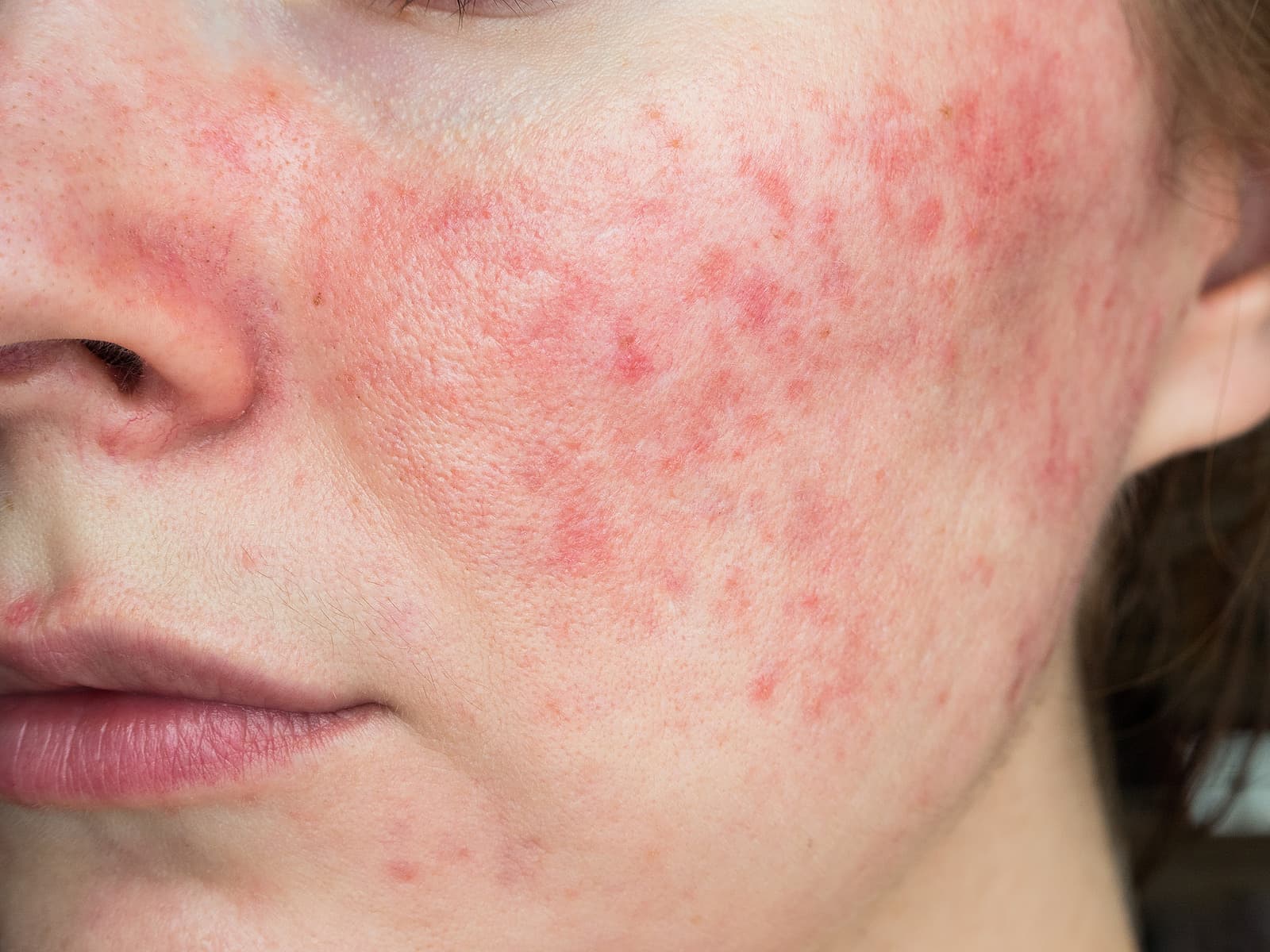
Many people suffer with rosacea, a common condition that causes flushing, persistent redness, visible blood vessels and even acne-like bumps on the skin of the nose and cheeks. Usually, dermatologists advise their rosacea patients to avoid triggers such as alcohol, spicy foods or excess sun. However, this strategy may not offer adequate relief, especially for more serious cases. Of course, people can take medications to ease rosacea. A new study suggests that certain topical medications may perform better than the standard first-line treatment.
Which Treatments Can Ease Rosacea?
Rosacea is a skin condition that affects as many as 16 million Americans. Dermatologists analyzed randomized controlled trials to determine the efficacy of topical treatments for moderate to severe rosacea (JAMA Dermatology, July 1, 2026).
In 32 RCTs that met the qualifications, the researchers found that topical ivermectin and encapsulated benzoyl peroxide were more effective than metronidazole, the standard treatment. Most of the studies included lasted two to four months. Both ivermectin (available as a generic or under the brand name Soolantra) and encapsulated benzoyl peroxide (brand name Epsolay) resulted in fewer lesions and a more favorable investigator global assessment.
Microencapsulated benzoyl peroxide was developed to be less irritating than the usual formulations used for acne vulgaris. Nonetheless, more people in these studies stopped using benzoyl peroxide than ivermectin or metronidazole due to side effects.
The investigators suggest that
“ivermectin may be particularly suitable for long-term maintenance therapy.”
You may wish to explore other treatments. One reader reports that light therapy really helps ease rosacea.
Light Therapy to Ease Rosacea
Q. I have suffered with rosacea for more than 30 years. I have tried all the treatments that I could find. The only thing that has helped me is light therapy.
I am thrilled with the results. which were immediate when I first started using it. I use it for three minutes daily now to maintain control.
The red light kills mites and reduces inflammation and redness better than anything I’ve tried.
A. Rosacea is a skin condition in which chronic inflammation leads to redness, pimples and sometimes lumps and bumps (called phyma). According to a recent review, there is evidence to support vascular lasers and light devices to treat the tiny blood vessels that cause redness (Skin Therapy Letter, July 2021). A recent study shows that pro-yellow laser can reduce the density of Demodex mites, which are linked to rosacea (Journal of Cosmetic Dermatology, March 20, 2021). We could find no controlled trials of red light treatment for rosacea but case reports of LED therapy are promising (Journal of Medical Case Reports, Jan. 28, 2020).
Medicines Against Rosacea
Ivermectin Against Skin Mites
Q. I keep reading about the ivermectin controversy for treating COVID-19. No one talks about the use of this drug to control rosacea. I use ivermectin in a compounded gel form for rosacea and it is quite effective.
Most people don’t realize that rosacea has a parasite component. It is unclear whether the parasite causes rosacea or is opportunistic in the presence of rosacea. Either way, this treatment works!
I had an extreme breakout a year ago that finally cleared up with doxycycline and the ivermectin gel. Now I use tiny amounts of both and have had no further flares.
A. Symptoms of rosacea include frequent blushing, persistently red skin and small bumps that look a lot like pimples, although they are not. Dermatologists suspect that some of these symptoms may result from the immune system reacting to the presence of skin mites, Demodex folliculorum. Although these are normal skin inhabitants, people with rosacea appear to host more of them, possibly due to subtle differences in immune response (Journal of Dermatology, Aug. 2021).
The FDA has approved topical 1 percent ivermectin cream under the brand name Soolantra. This treatment is effective for severe rosacea (Expert Opinion on Pharmacotherapy, April 2018).
Other Treatments for Rosacea
Q. Although I have tried topical metronidazole along with oral antibiotics, they don’t consistently ease rosacea. I have suffered with this condition for many years. Is there anything else that might work to control the redness and bumps?
A. Rosacea is an inflammatory skin condition with flushing, redness and dilated blood vessels on the face. Bumps and pimples may add to the distress.
There are no cures, but there are other treatments. Ask your doctor about the prescription drug Finacea. It is a topical gel containing azelaic acid. One study indicates that it is more effective than metronidazole (Archives of Dermatology, Nov. 2003).
There are some non-standard treatments worth discussing with your doctor. For example, one report from Italy suggested that dietary supplements containing silymarin and MSM (methylsulfonylmethane) may ease redness (Journal of Cosmetic Dermatology, March, 2008). However, when a person has pustules that resemble acne, topical ivermectin appears most effective (Dermatology and Therapy, Feb. 2021).
Moreover, many readers report that using a dandruff shampoo such as Selsun Blue on the face can help ease rosacea as well. Cleansing should be gentle, and dermatologists urge conscientious use of sunscreeen.
Photo by M. Sand, D. Sand, C. Thrandorf, V. Paech, P. Altmeyer, F. G. Bechara
CC 2.0 This photo has been cropped
Citations
- Amstutz AV et al, "Topical preparations for moderate to severe rosacea treatment: A systematic review and network meta-analysis." JAMA Dermatology, July 1, 2026. DOI: 10.1001/jamadermatol.2026.2062
- Kang CN-Y et al, "Rosacea: An update in diagnosis, classification and management." Skin Therapy Letter, July 2021.
- Temiz SA et al, "The effect of 577-nm pro-yellow laser on demodex density in patients with rosacea." Journal of Cosmetic Dermatology, March 20, 2021. DOI: 10.1111/jocd.14085
- Sorbellini E et al, "Coupled blue and red light-emitting diodes therapy efficacy in patients with rosacea: two case reports." Journal of Medical Case Reports, Jan. 28, 2020. DOI: 10.1186/s13256-019-2339-6
- Forton FMN & De Maertelaer V, "Which factors influence Demodex proliferation? A retrospective pilot study highlighting a possible role of subtle immune variations and sebaceous gland status." Journal of Dermatology, Aug. 2021. DOI: 10.1111/1346-8138.15910
- Sahni DR et al, "Ivermectin 1% (CD5024) for the treatment of rosacea." Expert Opinion on Pharmacotherapy, April 2018. DOI: 10.1080/14656566.2018.1447562
- Zhang H et al, "Rosacea treatment: Review and update." Dermatology and Therapy, Feb. 2021. DOI: 10.1007/s13555-020-00461-0