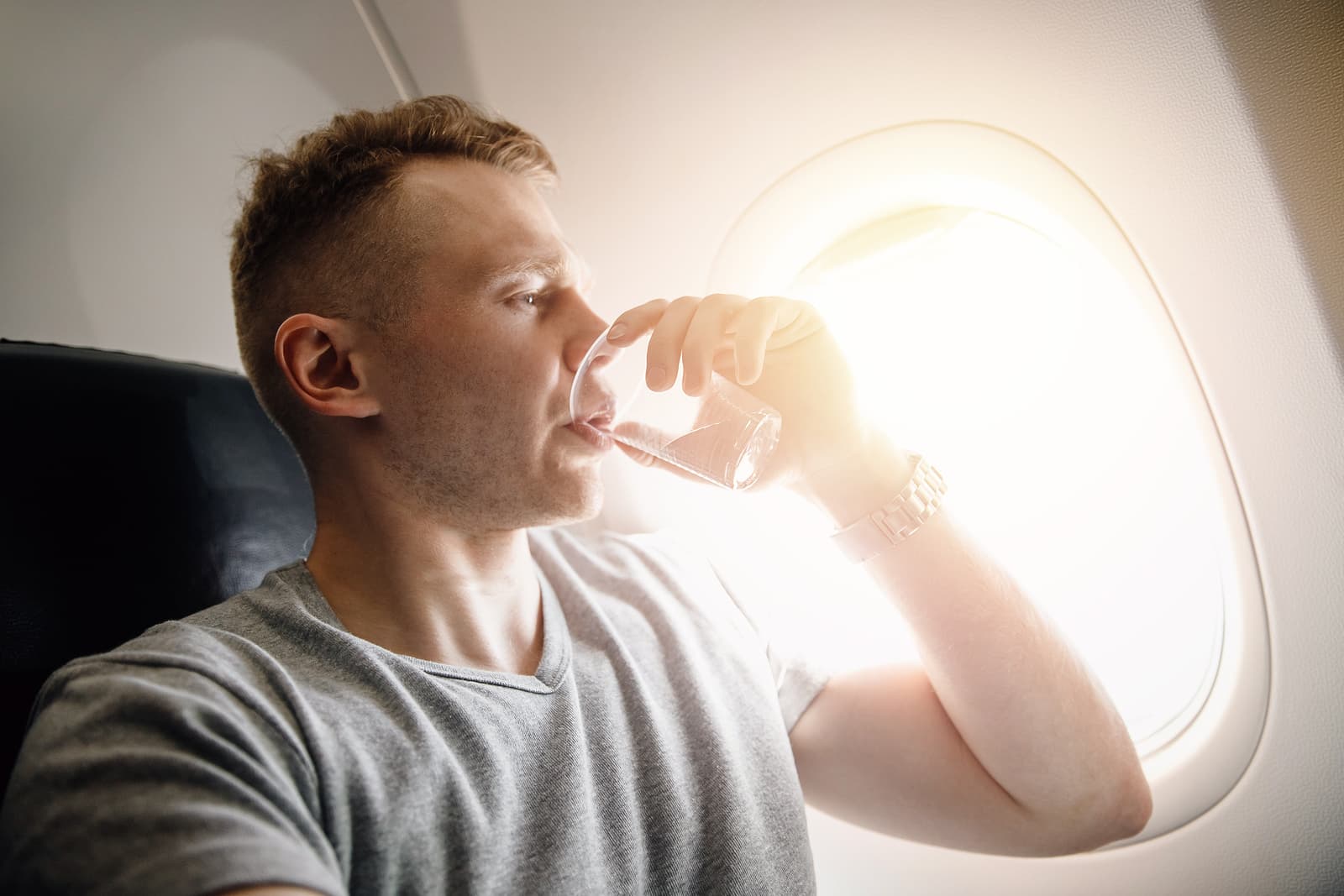
Frequent fliers often avoid drinking water on airplanes. That’s because they have been told that there are questions about the quality of water on airplanes. The latest data confirm that they are right.
Should You Drink the Water?
Results from the 2026 Airline Water Study were recently released by the Center for Food as Medicine and Longevity, which conducted the research. Back in 2019, that year’s Airline Water Study found a great deal of variability in water quality among different airlines (Airline Water Study 2019, DietDetective.com, Sept. 4, 2019). This year, the scientists also found large differences, with only a few airlines scoring well. The 2019 analysis covered 11 major and 12 regional airlines; in the 2026 study, there are 10 major and 11 regional airlines.
Airplanes must fill their drinking water tanks while they are at the airports they serve, so they are dependent on the water quality in those places. Trucks and hoses used to transfer the water can also affect its quality. The federal Aircraft Drinking Water Rule requires airlines to provide safe drinking water for both crew and passengers. To make sure it is, the water tank is supposed to be drained, disinfected and flushed four times a year. If an airline chooses to undertake this procedure only annually, it must test its drinking water monthly.
How Was the Study Conducted?
Researchers looked for E. coli and coliform contamination in 35,674 water samples over a three year period from October 2022 through September 2025. They analyzed Maximum Contaminant Level violations for E. coli. In addition, they monitored public notices and disinfecting frequency. Tabulating violations per aircraft and indicator-positive rates also contributed to the scores, which could range from 0 (dismal) to 5 (perfect). These translate to grades from F to A.
One national airline in the 2026 study had a perfect score of 5, earning Delta Air Lines a grade of A. Frontier Airlines also received an A, while Alaska Airlines came in just behind with a high B. Allegiant Air also earned a B. Others came in with Cs or Ds, a discouraging grade with respect to public health.
Regional airlines have a lot of room to improve. One, GoJet Airlines, did well with a high B. The others have Cs, Ds and one F.
How to Stay Safe on a Plane:
Drink only water bottled before coming on board. Purchase it after passing security screening.
Avoid coffee and tea. The crew makes them using the aircraft’s water.
Use extra caution on planes with international routes.
Instead of washing your hands in the bathroom, bring along your own hand sanitizer and use that instead. Make sure it is at least 60% alcohol so it will kill the germs that lurk in bathrooms. If you must use the water to wash up, let it run for at least 30 seconds to flush out the lines.
Why Is Water on Airplanes So Scary?
The people who reported on the 2019 Airline Water Study offered these scathing comments:
• “The “Shame on You” Award goes to the EPA and nearly all major airlines (regional airlines weren’t contacted) for their very poor response time and lack of cooperation answering detailed questions. The EPA didn’t answer most penalty-related questions, and Spirit, Allegiant and Frontier did not respond to any questions. Very weak responses – and responses that didn’t address questions – were provided by American, United, and JetBlue, which had a large number of violations during the past seven years.
• “Testing for coliform bacteria is important, because their presence in drinking water indicates that disease-causing organisms (pathogens) could be in the water system.”
Unfortunately, in 2026 the EPA continues to earn a “Shame on You” award for lax enforcement. The EPA appears to inflict civil penalties as provided by the ADWR rarely if ever.
As the authors note, poor quality water on airplanes is most dangerous for certain vulnerable groups of people: infants and young children, pregnant women, elderly people and those whose immune systems are suppressed. We hardly need to point out that these days many people are taking medications that tamp down the immune response.
Reader Comments:
How do you deal with water on airplanes? Do you order tea or coffee? Have you ever gotten sick after traveling on an airplane? We’re especially interested in digestive tract problems. Please share your story in the comment section.