Does a bad reaction hurt more when you applied the offending substance deliberately to help with healing? It may not, but certainly the knowledge that the problem might have been avoided can be grating.
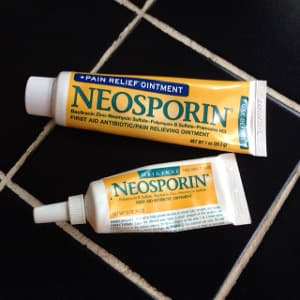
That is why many dermatologists now suggest that people avoid using the topical antibiotic neomycin. They have seen severe skin reactions to this compound, and they appear to be more common now than in past decades. Some readers report on first-hand experience of a nasty Neosporin reaction.
Can You Avoid a Neosporin Reaction?
Q. I know Neosporin is a very commonly used, topical healing medicine that is sold everywhere. But when I used it, I had red, itchy, blistering skin. Very unpleasant!
When I looked it up, I found that Polysporin has only two of the three ingredients in Neosporin: polymyxin B and bacitracin antibiotics. There is absolutely no neomycin in Polysporin, and I have not had any problems with it.
A. A surprising proportion of people experience allergic reactions to neomycin, one of the antibiotic ingredients in Neosporin. Danish researchers found more than 3% of adults and 4% of children developed a rash or other reaction (Contact Dermatitis, July 2025). They recommend restricting the use of neomycin to reduct the chance of a Neosporin reaction. That could be tricky in the US, where Neosporin is easily available without a prescription. Many dermatologists now recommend plain petroleum jelly (Vaseline) as the best treatment for minor wounds.
Neosporin Reaction Became Debilitating:
Q. I am severely allergic to latex, nickel and Neosporin. Now I am off work for two weeks due to a huge ulcerated lesion on my left knuckle.
I had a small paper cut, applied Neosporin and covered the cut with a latex-free bandage. That was a bad idea! I have been to two specialists, who said all I can do is let it heal before I return to work.
A. Neomycin is one of the antibiotics found in Neosporin ointment. Research suggests that one out of ten individuals reacts to neomycin with a nasty rash (Dermatitis, Jan-Feb, 2013).
What to Use Instead:
Some dermatologists now recommend using simple petrolatum on a minor cut to protect it. That avoids contact dermatitis due to an OTC topical antibiotic. Polymyxin and bacitracin, the other ingredients in Neosporin, may also be capable of triggering a reaction (Dermatologic Surgery, Aug., 2013).
Citations
- Jensen MB et al, "Prevalence of contact allergy to neomycin in dermatitis patients: A systematic review and meta-analysis." Contact Dermatitis, July 2025. DOI: 10.1111/cod.14784
- Fransway AF et al, "North American Contact Dermatitis Group patch test results for 2007-2008." Dermatitis, Jan-Feb, 2013. DOI: 10.1097/DER.0b013e318277ca50
- Nijhawan RI et al, "Mohs surgeons' use of topical emollients in postoperative wound care." Dermatologic Surgery, Aug., 2013. DOI: 10.1111/dsu.12245