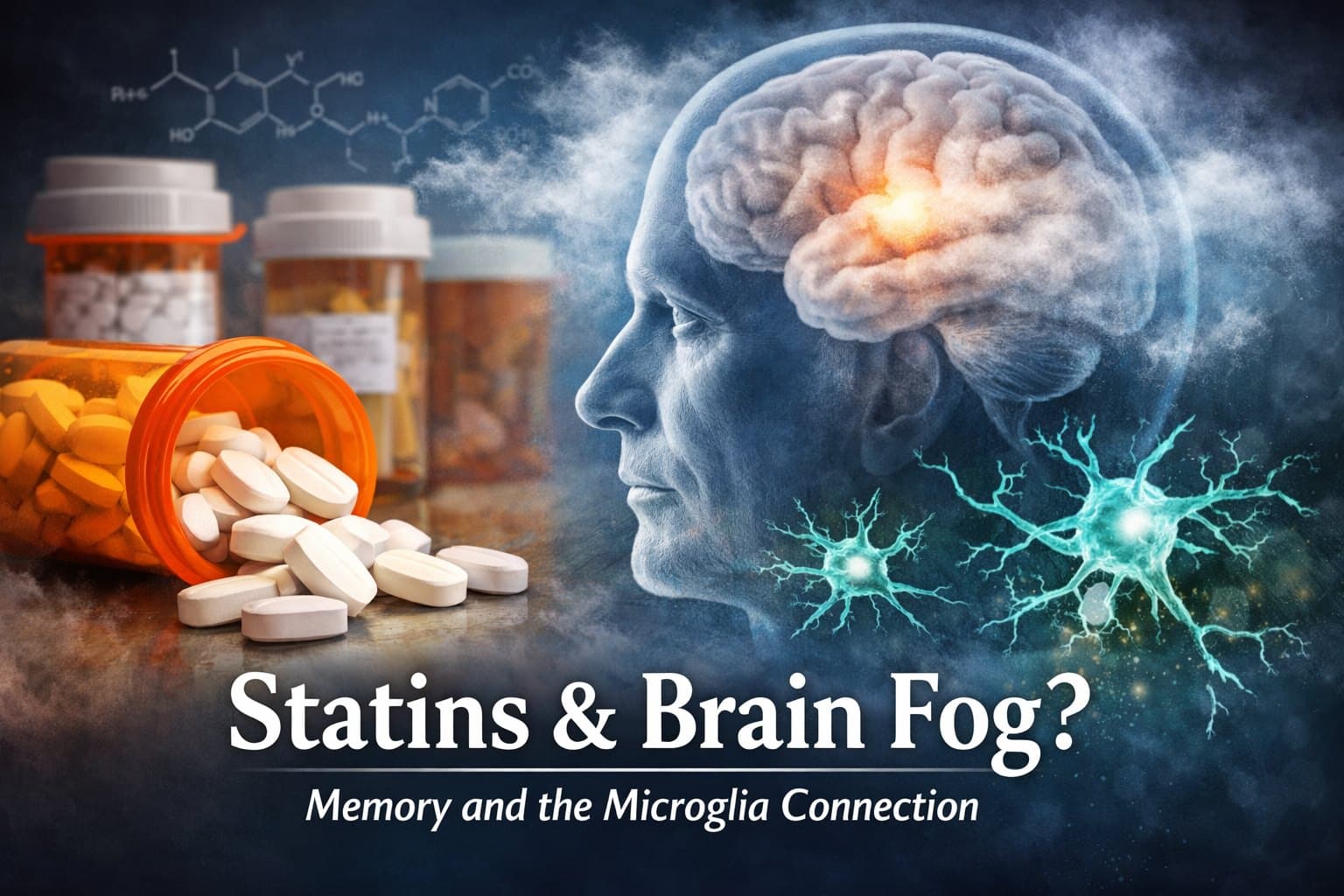
Statins seem to represent a never-ending source of controversy. These are, after all, the most prescribed drugs in America. According to our calculations, over 50 million Americans take medications such as atorvastatin, rosuvastatin, simvastatin, pravastatin or lovastatin. Do some people who take such cholesterol-lowering drugs experience memory problems? In other words, could there be a connection between statins and brain fog?
For decades, doctors have debated the pros and cons of statins. Some maintain that side effects are extremely rare and benefits crystal clear. Others suggest that side effects are more common than clinical trials reveal and that the benefits, while real, may be more modest than people realize. One of the most contentious issues is whether there is a plausible link between statins and brain fog. New research in the journal NeuroToxicology (March, 2026) has uncovered a possible explanation.
Statins and Microglia: A Clue to the Statins and Brain Fog Connection
We are not going to revisit the entire statin debate here. Instead, we want to focus on a specific and persistent question: Could statins affect memory and cognitive function? New research on statins and microglia may offer a biological explanation for what some patients have been reporting for years.
Here at The People’s Pharmacy, we have been collecting reader reports about statins and cognitive decline for more than two decades. Hundreds — possibly thousands — of real people have described real experiences: forgetting their children’s names, losing words mid-sentence, walking through their days in a mental fog so thick they feared they were developing Alzheimer’s disease. These aren’t hypochondriacs looking for excuses. Many of them noticed the problem, stopped their statin, and watched their thinking sharpen back up within weeks.
The Letter That Changed Everything
Over 25 years ago we received a letter from a physician by the name of Duane Graveline, MD:
Q. I am a retired family doctor and former astronaut (www.spacedoc.net). Two years ago at my annual astronaut physical at Johnson Space Center (JSC) I was started on Lipitor [atorvastatin]. Six weeks later I experienced my first episode of total global amnesia lasting six hours. They couldn’t find anything wrong with me so I suspected Lipitor and discontinued it.
Other doctors and pharmacists did not seem to be aware of similar problems. Believing it must have been a simple coincidence, I decided a year later to restart Lipitor. Six weeks later I was brought to the ER with a twelve-hour episode of total global amnesia. I am more convinced than ever of a Lipitor relationship.
Do you have any information on other people who may have had such an experience? I have my astronaut physical again in a few weeks and would like to tell the doctors about this if you have any data. This drug is in common use at JSC and for all I know other astronauts may be on it as part of their enthusiasm for preventive medicine.
A. Total global amnesia seems to be rare, but one person told us that Lipitor resulted in “big ugly holes burned through my memory.” According to Beatrice Golomb, M.D., Ph.D., Principal Investigator of the Statin Study at the University of California, San Diego, “We have received dozens of reports from people citing significant memory problems with Lipitor that seem to resolve with discontinuation. Some are from older people who have gone from very bright and verbal to not recalling the names of their children or grandchildren, in short order; and others are from younger people who have rather abruptly developed memory problems. Several have gone so far as to get work-ups for early Alzheimer’s in their 40s or early 50s, only to find that the problems resolved when they discontinued statin drugs.”
We suspect that such reactions are rare, but readers who would like us to forward their experiences with cholesterol-lowering drugs to the FDA can contact us via email: Questions@PeoplesPharmacy.com.
The letters poured in. People described a connection between statins and brain fog, memory problems and other cognitive challenges. Most healthcare professionals dismissed these complaints as imaginary or psychosomatic. But the letters were so poignant that we could not ignore them. Dr. Graveline went on to write several books about statins, including Lipitor, Thief of Memory.
Fast Forward 25 Years: Microglia, Statins and Brain Fog:
Even today, experts remain divided. Some studies conclude that statins do not impair memory. Others suggest that statins and brain fog is an under-recognized problem that needs more study.
The FDA has weighed in on this controversy.
Official prescribing information for statins such as atorvastatin includes this statement:
“There have been rare reports of cognitive impairment (e.g., memory loss, forgetfulness, amnesia, memory impairment, confusion) associated with the use of all statins. Cognitive impairment was generally nonserious, and reversible upon statin discontinuation, with variable times to symptom onset (1 day to years) and symptom resolution (median of 3 weeks).”
Some physicians have suggested that the FDA should remove this information from the prescribing information. But the question has never really gone away: Why would statins affect memory in some people but not others?
Perhaps the new research published in NeuroToxicology (March, 2026) may open the door to additional research and provide a plausible explanation for the connection between statins and brain fog.
Statins and Microglia: A New Scientific Explanation
The study in NeuroToxicology may provide some important clues about how statins affect the brain.
Researchers investigated how rosuvastatin (Crestor) affects brain cells and discovered something intriguing: the drug appeared to interfere with microglia.
Microglia are specialized immune cells in the brain. Think of them as a combination of scouts, housekeepers and emergency responders. They patrol the brain looking for infections, damaged cells, plaques and debris. Then they help clean up the mess and coordinate repair.
These cells are incredibly important. Microglia make up roughly 10 to 15 percent of all brain cells and play a crucial role in:
- Clearing damaged cells and protein debris
- Fighting infections in the brain
- Controlling inflammation
- Supporting neuron health
- Helping shape memory and learning
In other words, healthy microglia help keep the brain running smoothly.
How Do Statins Affect Microglia?
Please strap in because the research in NeuroToxicology (March, 2026) is complex. The title of this article is:
“Microglia as a key mediator in rosuvastatin-associated cognitive impairment”
Here is some of what the authors report about statins and brain fog:
“In this study, we chose rosuvastatin as a representative statin to explore the mechanisms underlying statin-associated cognitive impairment.
“Following central nervous system injuries or pathological conditions, microglia undergo dynamic reactive changes, a process broadly termed “activation”. Activated microglia have been implicated in numerous neurodegenerative disorders, including Alzheimer’s disease, Parkinson’s disease, and multiple system atrophy.
“The observed suppression of microglial phagocytosis by rosuvastatin at high concentrations raises concerns regarding its potential interference with the clearance of pathological proteins, a key mechanism in neurodegenerative pathologies. This impaired phagocytosis is a hallmark of microglial aging, implying that high-concentration rosuvastatin might induce a microglial state partially resembling that of aging microglia.”
Time out for a little explanation. Remember, we suggested that microglia are housekeepers. They gobble up pathogens and cellular debris. The medical term for this garbage collection is “phagocytosis.”
The key finding:
“Based on these findings, we propose a potential mechanism for rosuvastatin-associated cognitive impairment. At the phenotypic level, a high concentration (100 μM) of rosuvastatin alters microglial biology by promoting faster migration, weakening phagocytic capacity, influencing inflammatory cytokine levels, and inducing a senescent phenotype. These changes in microglial biological activity might be implicated in the process of cognitive impairment.”
The word senescent means roughly old and worn out. So, the suggestion seems to be that some statins can mess up microglia cells so that they may no longer carry out their housekeeping chores efficiently.
Why Microglia Matter for Memory:
If microglia are not doing their many jobs efficiently, this could account for statins and brain fog. Waste products could conceivably build up in the brain leading to inflammation and reduced neuronal efficiency. Smooth communication between brains cells could be disrupted. And some people may be more susceptible to this statin and brain fog effect than others.
Because we are all so different, I suspect that some people are far more vulnerable to statin side effects than others. Statins can help people with cardiovascular disease reduce the risk of heart attacks and strokes. But some unknown percentage of patients may experience side effects that affect muscles, blood sugar or possibly the brain.
The Bottom Line on Statins and Brain Fog and Microglia
The new research in NeuroToxicology does not end the debate about statins and brain function. But it does provide something that has been missing for years: a plausible scientific explanation for statin-associated cognitive symptoms.
The relationship between statins and microglia may turn out to be an important clue in understanding why some people experience memory problems, confusion or fuzzy thinking while taking these widely prescribed medications. Physicians like explanations and this may be a key one. Of course no one should ever stop taking a medication without careful consultation with the prescriber.
We suspect this controversy is far from over.
Please Share Your Statin Story
We have been collecting statin stories for decades. We want to hear from you. How have you reacted to medications such as:
- Atorvastatin
- Rosuvastatin
- Simvastatin
- Pravastatin
- Lovastatin
- Fluvastatin
- Pitavastatin
If you have taken such medications without any complications, please share your experience. If you have had side effects, we would also like to read your story in the comment section below.
If you think this article would be helpful for a physician, friend or relative, please email it, share it on social media or print it and mail it to those you think would benefit. Sometimes a scientific explanation for a mysterious condition, such as statins and brain fog, can be helpful.
Because we do our best to stay on top of the latest research, we need your help to keep The People’s Pharmacy healthy. Encouraging acquaintances to sign up for our newsletter is one way you can help. And if you can make a donation, we would be super grateful. Thank you for your support.
Citations
- Sang, X., et al, "Microglia as a key mediator in rosuvastatin-associated cognitive impairment," NeuroToxicology, March, 2026, https://doi.org/10.1016/j.neuro.2026.103405 Get rights and content