We recently ordered some baking supplies that included chocolate chips. Needless to say, what we actually received was a chocolate mess. The chips had melted in the heat. We should have known better than to order chocolate by mail in the summertime. That sticky disaster got us thinking again about prescription heat damage and a troubling question: If chocolate cannot survive a summer delivery truck, what happens to the medicine you depend upon?
This is not a theoretical concern.
On July 26, 2026, the Associated Press published a scary headline:
“Sweltering heat wave grips central and southern US for a second straight day”
The news article reported that at least 40 million Americans were under extreme heat warnings. Heat indexes topped 100 degrees from Minnesota to Mississippi, while Rapid City, South Dakota, reached a record 112 degrees.
The AP report added:
“Parts of the Southwest were expected to see highs of 120 degrees Fahrenheit (49 C), according to the National Weather Service.”
That is the temperature outside a delivery truck.
Inside the cargo compartment, temperatures may climb far higher. Packages can then spend additional hours in a metal mailbox or sunny spot on the front porch.
So, what happens to pills, inhalers, creams, insulin, eye drops and other medicines while they are cooking in transit?
Prescription Heat Damage Starts Before the Mailbox
Most people understand that certain products should not be shipped casually during hot weather. We were incredibly short-sighted to include chocolate in a baked goods delivery. That’s on us. The company should also have recognized that shipping chocolate chips in July was a big mistake.
Other products that should probably not be shipped when it is hot include wine, meat, poultry, seafood, ice cream, eggs, milk, yogurt, cheesecake, gummies, dietary supplements, nut butters, cut fruit, candles, crayons, deodorant sticks, makeup, sunscreen, lipstick and perfume.
Medicine is rarely included on that list. It should be!
The official prescribing information sanctioned by the Food and Drug Administration often specifies medication storage at room temperature (68 to 77 F).
“During shipping, temporary fluctuations are allowed between 50 and 86 F.”
Those numbers appear repeatedly in FDA-approved prescribing information. They are not merely suggestions for making pills comfortable. They reflect the temperatures at which manufacturers have data supporting a medication’s stability through its expiration date.
Ask any delivery driver if the back of the truck gets warmer than 86 degrees in the summertime and they are likely to laugh at you. Some have gone so far as to post photos of thermometers in the cargo compartment. These can reach 120 degrees or even higher.
A New York Times article (Aug. 13, 2024) by Emily Baumgaertner was titled:
“Hot Summer Threatens Efficacy of Mail-Order Medications“
Here is how Emily described the problem:
“Millions of Americans now receive their prescription medications through mail-order shipments, either for convenience or because their health plans require it. But the temperatures inside the cargo areas of delivery trucks can reach 150 degrees Fahrenheit in the summer, according to drivers — far exceeding the range of 68 to 77 degrees recommended by the national organization that sets standards for drug handling.”
Once a medicine is delivered, it may sit in a hot mailbox or on a sunny front porch for hours. What does this do to the medication? It would be a good idea to grab your medications as soon as they are delivered. But many folks have to work, and they may not get home until late in the day.
Lynne’s Sister Spent 31 Years With the Postal Service
“Medicines were in the hot trucks, with no air conditioning, all day, so it did not matter how fast you got to the mailbox. Your medicine was already hot!”
That is an important point. The mailbox may be only the final oven in a much longer cooking process.
Researchers Test Mail-Order Shipping Temperatures
Scientists have tried to determine what ordinary packages experience during shipment. A study published in the Journal of the American Pharmacists Association (May-June 2023), monitored simulated mail-order medication shipments during different seasons, using various carriers and shipping methods.
The investigators compared package temperatures with the United States Pharmacopeia controlled-room-temperature range of 68 to 77 degrees F. The result was alarming:
Packages spent an average of 68.3 percent of transit time outside the recommended temperature range. The researchers reported that package temperatures were outside the recommended range for most of the journey regardless of the carrier, shipping method or season.
These findings do not prove every medication in every shipment was damaged. Drugs differ greatly in their sensitivity to heat, moisture and cold. A brief rise to 90 degrees may have no meaningful effect on one tablet but could be important for another product. It does prove something else, however: The assumption that ordinary parcel delivery maintains “room temperature” is not credible.
When Prescription Heat Damage Could Be Life-Threatening!
I would not want an EpiPen to sit in the back of a delivery van for hours during the summer.
The company states:
- “Store EPIPEN at room temperature between 68° F to 77° F (20° C to 25° C).
- “Keep protective case in the outer carton to protect from light. When exposed to air or light, epinephrine changes quickly to a pinkish or brown color and should not be used.
- “Do not expose to extreme cold or heat. For example, do not store in your vehicle’s glove box or trunk. Do not store in the refrigerator or freezer.“
Someone experiencing anaphylactic shock due to a bee sting should not have to worry about prescription heat damage! Epinephrine (adrenaline) must work perfectly every time!
An Arizona Mailbox Becomes an Oven
Several years ago, a retired professor of molecular biology decided to conduct his own experiment. He placed an accurate electronic thermometer in his mailbox in Tempe, Arizona, and recorded temperatures from August through October.
The average daily mailbox temperature was 121 degrees F. On some days, it reached between 130 and 140 degrees. Even on the coolest days of his experiment, the temperature rose to at least 95 degrees.
After analyzing his results, he stopped obtaining prescriptions by mail.
His mailbox experiment was not a controlled drug-stability study. It nevertheless demonstrated what a prescription package may encounter after the carrier considers the delivery complete.
Another reader was concerned about prescription heat damage
A black mailbox in Texas:
“I’ve measured temperatures as high as 118 F in my mailbox. The outside of my neighbor’s black mailbox registered above 140. Our mail-order pharmacy has medicines placed in the mailbox by default rather than ringing the doorbell.”
At 140 degrees, we are no longer talking about a minor “excursion” above 86 degrees.
What Does Heat Actually Do to Medicine?
Heat can accelerate chemical reactions. It can speed the breakdown of active ingredients, alter coatings and capsules, promote evaporation, affect pressurized inhalers and change the physical properties of creams, suppositories, suspensions and other formulations.
Moisture can add another layer of trouble. Humidity may promote degradation or cause some tablets and capsules to soften, swell, crumble or stick together.
The result is not necessarily a medicine that looks or smells spoiled. A pill can appear perfectly normal even if its potency has declined. The consequences may also be subtle. The medication may simply stop working as well.
Blood pressure may creep upward. Seizures may become harder to control. Asthma symptoms may return. Blood sugar may rise. An infection may fail to respond as expected.
The patient and prescriber may conclude that the underlying condition is getting worse. The doctor may increase the dose or add another drug without suspecting that the medication itself was compromised somewhere along the supply chain.
Prescription Heat Damage Affected an Asthma Drug
Researchers at the Carl T. Hayden VA Medical Center in Phoenix, AZ, investigated what happened when capsules containing the asthma medicine formoterol were subjected to high temperatures.
Their “Study Objectives:”
“Based on anecdotal reports of formoterol aggregating in mailboxes in the summer in Arizona, we examined the effect of heat on formoterol as well as on drug delivery.”
They exposed the product to temperatures ranging from 104 to 158 degrees F. Heating reduced the amount of powder delivered from the capsules.
The researchers reported:
“The present study demonstrates that heating formoterol to temperatures that might be encountered during an Arizona summer lowers powder delivery. Combined with the reports from patients who received deformed formoterol capsules in mailboxes during summer months, it seems likely that temperature led to the decrease in powder delivery.”
This study does not mean every asthma inhaler or capsule will be ruined on a hot day. It does demonstrate that temperatures encountered in real-world delivery can change the performance of at least some medications.
Here are the authors’ recommendations to avoid prescription heat damage:
“Based on the above results, we recommend caution in the mailing or transport of drugs that might be heat-sensitive. In this context, the Carl T. Hayden Veterans Affairs Medical Center in Phoenix no longer mails formoterol to patients but requires patients to pick up medications at the pharmacy during the summer months. An alternative strategy would be for mail-order pharmacies to pack the drug in dry ice to avoid this problem. Moreover, physicians should counsel patients to read the storage instructions on medicines. If there are cautions about heat exposure, patients should make sure the mail-order pharmacy ships the drugs in a way that avoids this problem. Furthermore, patients are warned not to leave medications in the car.”
Which Medicines Are Vulnerable to Prescription Heat Damage?
Any prescription that arrives unusually hot deserves attention, but certain products call for special caution.
They include:
- Insulin and other injectable diabetes medicines
- Semaglutide products such as Ozempic and Wegovy
- Tirzepatide products such as Mounjaro and Zepbound
- Biologic drugs and monoclonal antibodies
- Vaccines
- Transplant and anti-rejection medicines
- Nitroglycerin
- Epinephrine auto-injectors
- Liquid antibiotics and other suspensions
- Compounded medicines
- Suppositories
- Hormone products
- Eye drops
- Inhalers and aerosol products
- Thyroid medicine
- Anti-seizure drugs
- Medicines with a narrow therapeutic range
Refrigerated drugs require especially careful handling, but ordinary tablets should not automatically be considered invulnerable.
The FDA advises that unopened insulin generally be refrigerated at approximately 36 to 46 degrees F. Product-specific rules vary, and some insulin may remain usable at room temperature for a limited period. Excessive heat and freezing can reduce effectiveness.
Patients should always consult the instructions for their exact product rather than assume that all insulin, injectable drugs or biologics have identical storage requirements. How can you do that? It is surprisingly easy. Just go to
DailyMed
You will see a prominent search box at the top of the page. Put in the name of your medicine…such as Lipitor (atorvastatin). In the case of Lipitor/atorvastatin scroll down to # 16 (HOW SUPPLIED/STORAGE AND HANDLING):
Storage:
“Store at controlled room temperature 20-25°C (68-77°F).”
“It Should Probably Be Okay” Is Not a Scientific Answer!
Patients who call mail-order pharmacies after receiving hot medicine may hear some variation of:
“It should still be okay.”
Perhaps it is. But “probably” and “should” are not measurements.
No one can reconstruct the journey merely by touching the package after delivery. How hot did it get? Did it remain at that temperature for 10 minutes, five hours or two days? Was it also exposed to excessive humidity? Did it cool down before the patient opened the package?
Without a temperature monitor or detailed shipping record, no one knows. A former mail-order pharmacy technician described the predicament:
A Pharmacy Technician Speaks Up
“Temperature was our enemy, but we did our best. We shipped medicines that had to be kept cool in Styrofoam containers with ice packs. We avoided shipping perishables on Friday so they would not sit in hot warehouses over the weekend.
“Even so, we received daily calls from people whose medications arrived hot or freezing. Our pharmacists’ best guess was, ‘It should still be okay,’ because we had no control over the shippers’ procedures.”
To the pharmacy’s credit, this employee said questionable products were replaced. Unfortunately, the replacements sometimes encountered the same temperature problems.
A Life-Saving Medicine Arrived Hot
Loretta Boesing’s experience shows why this issue matters. Her young son received a liver transplant and needed medicine to prevent his body from rejecting it. When the insurance company required mail-order delivery, the drug arrived during 102-degree weather and felt warm or hot.
Within two weeks, her son began suffering signs of rejection. In the hospital, the same medication worked when it came from a supply that had not been subjected to the delivery heat.
One case cannot establish with certainty that heat caused the failure. For Loretta, though, the experience was too serious to dismiss. She founded Unite for Safe Medications and began pushing regulators and pharmacy boards to address temperature conditions during delivery.
Her organization collaborated with pharmacy students on a project that mailed packages containing temperature monitors to participants. Roughly 80 percent exceeded the specified limits. That finding echoes the published research: Ordinary shipping methods frequently do not maintain ordinary room temperature.
We had the honor of interviewing Loretta Boesing on our nationally syndicated public radio show, The People’s Pharmacy. We think you will be as shocked as we were to hear her story at this link:
Show 1351: Are You Risking Your Life Trusting Mail Order Medicines?
Who Is Responsible for Prescription Heat Damage?
This question has produced years of finger-pointing. The original manufacturer establishes storage requirements. A wholesaler transports the drug. A mail-order pharmacy fills the prescription. A parcel company or postal service carries it. A PBM or insurance company may have required the patient to use mail order in the first place.
When a drug arrives hot:
- The pharmacy may blame the carrier.
- The carrier may say the shipper selected the packaging.
- The insurer may refer the patient back to the pharmacy.
- The manufacturer may not know the duration or extent of the heat exposure.
- The patient is left holding the package.
The FDA sets and enforces manufacturing and drug-quality requirements, but retail pharmacy practice and patient-level delivery are also subject to state laws and state boards of pharmacy. The patchwork creates an enormous accountability gap after a prescription leaves the pharmacy.
The 2023 shipping study stated the problem bluntly: There were no regulations requiring monitoring or reporting of storage conditions for nonspecialty oral medications after they left the pharmacy. In other words, the temperature standards are detailed, but the journey to the patient may be largely invisible.
The Bottom Line On Responsibility
As far as we can tell, no one has responsibility from beginning to end when it comes to maintaining or monitoring pharmaceutical standards.
Don’t Medicines Delivered to Local Pharmacies Face the Same Problem?
Carl raised a question that deserves a straight answer:
What About Medicines at the Corner Drugstore?
“Don’t the same concerns apply to drugs we buy at pharmacies, grocery stores and big-box stores? How do we know how the drugs were shipped to the sellers?”
He is absolutely right. Home delivery is only the most visible part of a much longer supply chain.
An active pharmaceutical ingredient (API) may be manufactured in China, shipped to India, combined with inactive ingredients and turned into finished tablets. Those pills may then travel to the United States by ship or aircraft. After reaching a port, they are inspected, moved to warehouses, wholesalers, pharmacy distribution centers and individual stores.
At every stage, temperature and humidity could matter.
Established pharmaceutical distributors may use validated procedures and climate-controlled facilities, and may keep temperature records. But patients usually cannot inspect those records, and the degree of monitoring may vary by product and company.
A local pharmacy is not an ironclad guarantee. A question we frequently ask is: do drug wholesalers that distribute to local pharmacies use temperature-controlled trucks? We have not received good answers.
The neighborhood pharmacy does offer some advantages, though. The medicine does not have to complete the final trip in a parcel truck or sit in the patient’s mailbox. A pharmacist may also be available for a face-to-face conversation if the medication looks unusual or fails to perform as expected.
A Health Care Insider Raises the Alarm
One reader spent more than 40 years administering medicines and vaccines. The account is disturbing:
An Insider Questions the Supply Chain
“Publicly, my employer was adamant about maintaining temperature logs to ensure product safety. Privately, I was repeatedly reprimanded for speaking up or refusing products from our contracted distributor.
“These were large quantities of expensive and life-saving products that were far outside the recommended temperature range for unknown periods. Yet I was told not to question or refuse them.
“If consumers only knew. Transportation and storage of pharmaceuticals are huge red flags for me.”
We cannot independently verify what happened at that facility. Nevertheless, the account exposes an obvious conflict: Rejecting a large shipment of expensive medicine can cost an organization a great deal of money. Accepting it may shift the risk to patients.
What Should You Do When Medicine Arrives Hot?
Do not automatically take the medicine, but do not throw it away either. You may need the package, lot number and shipping information to obtain a replacement.
- Bring the package inside immediately
Sign up for delivery alerts and retrieve prescriptions as soon as possible. Ask a neighbor, relative or building manager to help when you will not be home.
This will not undo heat exposure earlier in the journey, but it can prevent additional hours in a hot mailbox or on a sunny porch.
- Photograph everything
Take pictures of the unopened parcel, shipping label, packaging, ice packs, temperature indicator and medication container.
Document anything unusual:
- Warm or hot packaging
- Melted ice packs
- Swollen or stuck capsules
- Crumbling tablets
- Cloudiness, discoloration or separation
- Leaking containers
- Melted creams or suppositories
- Damaged inhalers
- A temperature monitor showing an excursion
Record the outdoor temperature, delivery time and the time you retrieved the package.
- Check the official storage instructions
Read the pharmacy label, Medication Guide and manufacturer’s prescribing information. Search for “How Supplied/Storage and Handling” in DailyMed.
Do not assume that the familiar 59-to-86-degree excursion range applies to every product. Some drugs must remain refrigerated. Others may tolerate limited room-temperature storage but cannot be returned to the refrigerator afterward. Some must never freeze.
- Call the dispensing pharmacist
Ask specific questions:
- What temperatures can this exact product tolerate?
- For how long?
- Is that answer based on manufacturer stability data?
- Does the pharmacy know the highest temperature reached during shipping?
- Was a temperature logger included?
- Will the pharmacy document this as a suspected temperature excursion?
- Will it replace the medication?
“Probably fine” is not the same as product-specific stability information.
- Contact the manufacturer
The manufacturer’s medical-information department may possess stability data that are not included in the package insert.
Be ready to provide:
- Drug name and strength
- Dosage form
- Lot number
- Approximate maximum temperature
- Estimated duration of exposure
- Whether the package was opened
- Whether the medication looks different
The problem, of course, is that without a monitor you may not know the actual maximum temperature or duration.
- Do not stop a critical medicine without a plan
Abruptly stopping insulin, anti-seizure medicine, anticoagulants, transplant drugs, steroids or heart-rhythm medicine can be dangerous.
Ask the pharmacist and prescriber how to maintain treatment while the shipment is evaluated or replaced. An emergency supply from a local pharmacy may be necessary.
- Request a replacement when safety cannot be established
When the exposure was clearly outside the manufacturer’s specifications and the pharmacy cannot verify stability, ask for a replacement at no charge.
The replacement should be shipped with appropriate insulation, expedited delivery and a temperature indicator. Sending an identical package by the same route during the same heat wave is not much of a solution.
- Report continuing problems
Complaints can be submitted to:
- The mail-order pharmacy
- The insurance company or PBM
- The state board of pharmacy
- The medication manufacturer
- FDA MedWatch when product quality or harm is suspected
- The patient’s employer benefits department, when an employer plan mandates mail order
Keep names, dates, case numbers and copies of correspondence.
How to Reduce the Risk Before the Next Shipment
Patients should not have to become logistics experts to obtain dependable medicine. Until the system improves, however, these steps may help:
- Ask whether local-pharmacy pickup is allowed during extreme heat.
- Request an override from the insurer for a temperature-sensitive drug.
- Schedule delivery for a day when someone will be home.
- Avoid Friday shipments that could spend a weekend in a warehouse.
- Use signature-required delivery where practical.
- Send the package to an air-conditioned workplace, staffed parcel counter or trusted neighbor.
- Ask for insulated packaging and expedited shipment.
- Request a temperature indicator or electronic data logger.
- Avoid storing medicine in a car, trunk, glove compartment or bathroom.
- Examine ice packs and temperature strips immediately.
- Ask an independent pharmacy whether it offers local climate-controlled delivery.
Insurance companies sometimes describe mandatory mail order as convenient. It is not convenient when the patient must spend hours trying to determine whether a costly prescription has been cooked.
The Simplest Solution: Put a Monitor in the Package
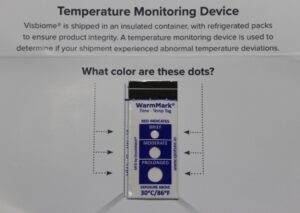
Shipping temperature monitoring device
Temperature indicators are already used for vaccines, biologic medicines, food and other sensitive products. Some are relatively inexpensive. Purchased in bulk, they might cost a couple of dollars each. Every prescription package does not need an elaborate laboratory instrument. A device that signals whether the contents exceeded the product’s permitted range would be a meaningful start.
For higher-risk medicines, an electronic logger could record both temperature and duration throughout transit.
A temperature monitor would not prevent poor handling, but it would replace guesswork with evidence. If the shipment remained within specifications, the patient would have reassurance. If it did not, the pharmacy could replace the medicine and investigate where the process failed.
Mail-order pharmacies, PBMs and insurers save money by channeling millions of prescriptions through centralized operations. A small portion of those savings should be used to prove that the medicine reached the patient under appropriate conditions.
Not My Problem!
We have been agitating for many years about the lack of responsibility when it comes to monitoring or enforcing FDA’s guidelines. Here is what we have discovered:
- The FDA takes NO RESPONSIBILITY! In essence, we hear that shipping conditions are not its problem. The agency just sets the standards.
- The USP takes NO RESPONSIBILITY! It has no authority to enforce storage or shipping standards.
- Brand-name companies have rigorous standards for storage and shipping, but once their temperature- and humidity-controlled trucks drop medicines off at a wholesaler or distribution center, they shrug and say it is no longer their problem.
- Chemical companies may not monitor the active pharmaceutical ingredients (APIs) they ship from plants in China or other countries. They just supply the “raw” ingredients.
- Generic drug manufacturers in India, Thailand, Guatemala, etc. may not always monitor their shipments from the plant to the dock to the final destination.
- Shipping companies may not maintain strict “room temperature” (68-77°F) guidelines inside their containers on airplanes or large cargo ships.
- U.S. Customs officials may not promptly inspect pharmaceuticals that arrive at ports of entry such as Houston, Los Angeles or Charleston.
- Shipping companies may not monitor every truck continuously as it makes its way from a port of entry to a distribution hub.
- State Boards of Pharmacy do not have responsibility as a shipment crosses from one state into another state. They are responsible only for what happens within their own state.
Prescription Heat Damage Should Not Be the Patient’s Problem
We would not accept a shipment of fish that spent all afternoon in a 120-degree truck. We would not serve melted-and-rehardened ice cream to our families and simply hope it was okay.
Medicine deserves at least as much care as chocolate, fish or frozen food.
Patients should not be forced to guess whether a life-saving drug survived its journey. Nor should they be expected to pay for a replacement when a delivery system exposed the prescription to conditions far outside the manufacturer’s instructions.
Regulators, state pharmacy boards, insurers, PBMs, mail-order pharmacies, wholesalers and carriers need to establish who is responsible at every point in the chain. Without federal oversight, though, that is unlikely.
At minimum, patients deserve:
- Product-appropriate packaging
- Meaningful temperature monitoring
- Clear instructions after an “excursion”
- Prompt replacement of questionable medicine
- Freedom to use a local pharmacy when safe delivery cannot be guaranteed
Until those protections exist, pay close attention to every prescription that arrives at your home. Feel the package, inspect the contents, read the storage instructions and ask hard questions.
Your medicine may have traveled halfway around the world before reaching your mailbox. You deserve proof that it survived the trip.
Final Words:
I know this article was long! If you made it this far, you recognize that we are passionate about this topic. Perhaps you would be willing to share this message with friends and family. That would be most appreciated. It astonishes us how many vulnerable products are now delivered directly to homes or mailboxes with no regard for temperature or humidity.
Your support is incredibly valuable. Our newsletter can only survive if it continues to grow. Here is a link to share with acquaintances. We would also be grateful if you would share your experience with mail-order meds in the comment section below. Thank you for your support.
Citations
- Chowdhury, D.A., et al, "Evaluation of temperature excursions from USP <659> recommendations during mail transit," Journal of the American Pharmacists Association (May-June, 2023), doi: 10.1016/j.japh.2023.02.002
- Robbins, R.A., et al, "Heat Decreases Formoterol Delivery," Chest, Dec. 2005.