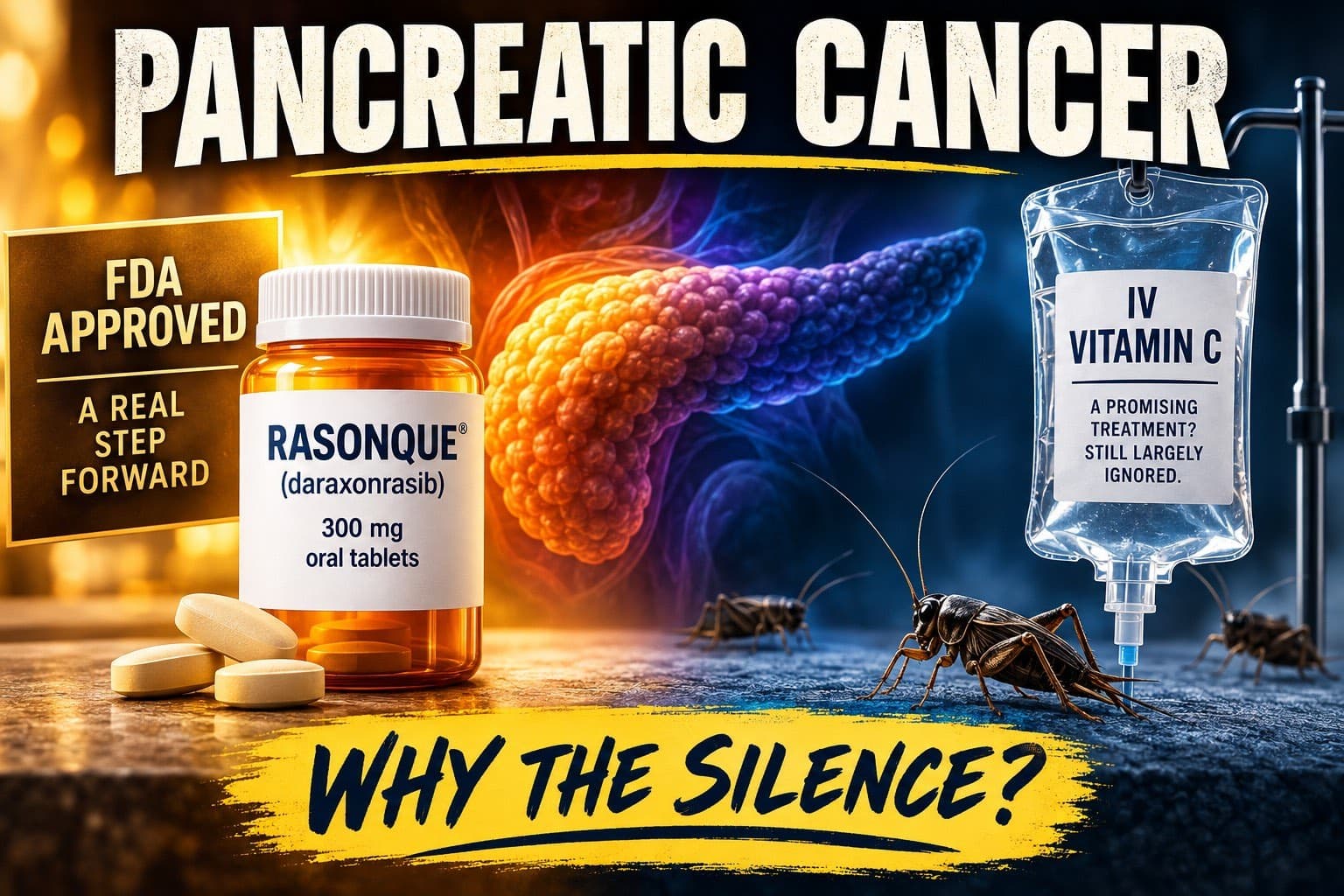
Pancreatic cancer is one of the most frightening diagnoses anyone can ever receive. That is why a new pancreatic cancer treatment approved by the FDA on August 26, 2026, deserves to be celebrated. The drug, daraxonrasib (Rasonque), substantially prolonged survival in people with previously treated metastatic pancreatic cancer. But amid the standing ovations, glowing headlines and expedited FDA review, we have a question: Why has provocative research on high-dose intravenous vitamin C received so little attention?
First, let us make one thing absolutely clear. We are delighted that people with metastatic pancreatic cancer have a new treatment option! This is a notoriously difficult cancer to treat, and progress has been painfully slow.
But there is another story here. It involves a treatment that cannot be patented in the usual way, has been around for generations and comes with none of the glamour of a brand-new targeted cancer drug.
It is vitamin C.
FDA Fast-Tracks a New Pancreatic Cancer Treatment
On August 26, 2026, the Food and Drug Administration announced its approval of Rasonque (daraxonrasib) for adults with metastatic pancreatic adenocarcinoma who have received at least one previous systemic treatment or who are not candidates for multiagent systemic therapy.
The Headlines:
The Wall Street Journal for August 26, 2026:
“FDA Approves Drug for Pancreatic Cancer in Milestone for Treatment of Deadly Disease
Revolution Medicines’ therapy slows a cancer that kills seven out of eight patients within five years”
Reuters for August 26, 2026:
“Revolution’s lifesaving pancreatic cancer drug wins speedy FDA approval”
New York Post for August 26, 2026:
“FDA approves ‘life-altering’ pancreatic cancer drug that nearly doubles life expectancy”
The FDA described Rasonque as a:
“First in Class Targeted Therapy for Metastatic Pancreatic Cancer”
Unlike traditional chemotherapy, daraxonrasib inhibits RAS proteins. Mutations involving the RAS pathway are major drivers of pancreatic ductal adenocarcinoma. The agency was clearly enthusiastic. It granted Rasonque “Breakthrough Therapy” and “Orphan Drug” designations as well as “Priority Review.” The application was also handled through the FDA Commissioner’s National Priority Voucher pilot program.
Perhaps most striking, FDA officials reported that the drug was approved 6.5 months before its user-fee deadline.
FDA Oncology Center of Excellence Director Angelo de Claro, MD, called the results “unprecedented.”
The FDA announcement is available here: FDA: Rasonque approval, Aug. 26, 2026
Why Oncologists Are So Excited About Rasonque Pancreatic Cancer Treatment
The excitement is understandable. The pivotal RASolute 302 study involved 500 people with previously treated metastatic pancreatic ductal adenocarcinoma. Researchers randomly assigned 248 participants to daraxonrasib and 252 to chemotherapy.
The results, published in the New England Journal of Medicine (July 23, 2026) were impressive.
Median overall survival was:
- Daraxonrasib: 13.2 months
- Chemotherapy: 6.7 months
Progression-free survival also improved:
- Daraxonrasib: 7.2 months
- Chemotherapy: 3.6 months
In other words, both overall survival and the time before the cancer progressed were roughly doubled.
These are not trivial improvements.
Nor was daraxonrasib simply trading longer survival for intolerable toxicity. Treatment discontinuation because of treatment-related adverse reactions occurred in only 1.2% of patients taking daraxonrasib compared with 11.2% of those receiving chemotherapy. Serious adverse effects still occurred, however, and rash, diarrhea, mouth inflammation, nausea, fatigue, vomiting, abdominal pain, edema, decreased appetite and bleeding are among the adverse reactions FDA lists for the drug.
A Standing Ovation for This Pancreatic Cancer Treatment
When the results were presented at the 2026 meeting of the American Society of Clinical Oncology, oncologists were ecstatic.
The BMJ (June 4, 2026) reported that the presentation prompted a “standing ovation.”
ASCO (American Society of Clinical Oncology) itself declared:
“The RAS revolution is here.”
And Rachna Shroff, MD, of the University of Arizona Cancer Center described the results as “landscape-changing.”
STAT (August 26, 2026) quoted pancreatic cancer specialist Andrew Ko, MD, of the University of California, San Francisco:
“It will be transformative in the way we treat pancreas cancer.”
He went on to call it the biggest advance in pancreatic cancer in decades.
We understand the enthusiasm.
But Rasonque is not a cure.
Median survival of 13.2 months means half the people in the trial died before that point and half survived longer. It represents a major advance over the chemotherapy used in this trial, but pancreatic cancer remains a devastating disease. Some people have wondered if Dolly Parton might have died from pancreatic cancer because the official account described “a brief battle with cancer.”
One oncologist summarized the new drug: this is not a cure, but it may be the best option yet for these patients.
Then There Is the Price
There is another number worth contemplating. The wholesale acquisition cost of Rasonque is $39,800 for a 30-day supply. That approaches $478,000 for 12 months of treatment. Insurance may cover much of that expense for many patients, but ultimately everyone pays more because of increases in insurance premiums or Medicare payments.
We are not suggesting that an effective cancer medicine should be rejected because it is expensive. Developing innovative targeted drugs is costly, risky and scientifically challenging.
But when Congress passed the Orphan Drug Act in 1983, there was an understanding that such drugs would not become profitable for the pharmaceutical industry. The FDA initially called the program it created to explore such medications the “Committee on Drugs of Limited Commercial Value.”
The Merriam-Webster Dictionary defines orphan drug as:
“a drug that is not developed or marketed because its extremely limited use makes it unprofitable”
You can learn more about this incredible reversal at this link:
Orphan Drugs Have Become a Billion Dollar Bonanza for Big Pharma
Orphan drugs are huge money makers for drug companies. These medicines save lives but the cost is unlikely to be sustainable for much longer
The price of Rasonque makes what happened to another pancreatic cancer study especially interesting.
The Pancreatic Cancer Treatment Almost Nobody Heard About
In 2024, investigators at the University of Iowa published a randomized clinical trial in the journal Redox Biology (November, 2024).
Its title was not especially sexy:
“Pharmacological ascorbate” is high-dose intravenous vitamin C.
Patients with stage IV pancreatic cancer were randomly assigned to standard chemotherapy with gemcitabine plus nab-paclitaxel or to the same treatment plus intravenous vitamin C.
This was not a vitamin pill from the health-food store. The patients received 75 grams of vitamin C intravenously three times a week.
And here is where things become fascinating.
Median overall survival was:
Chemotherapy plus IV vitamin C: 16 months
Chemotherapy alone: 8.3 months
Median progression-free survival was:
Vitamin C group: 6.2 months
Standard-treatment group: 3.9 months
Adding high-dose vitamin C did not worsen quality of life or increase the frequency or severity of adverse events. You can read the entire study for yourself, free of charge, here:
Redox Biology: Randomized IV vitamin C pancreatic cancer trial
Don’t Compare These Pancreatic Cancer Treatment Trials Head-to-Head
At first glance, you might be tempted to put the numbers next to one another:
Daraxonrasib: 13.2 months
IV vitamin C plus chemotherapy: 16 months
Please don’t. That would not be scientifically legitimate. The daraxonrasib study enrolled 500 patients and was a large international phase 3 trial in people whose metastatic disease had already been treated.
The vitamin C study randomized only 36 patients, and 34 actually received their assigned therapy. It studied vitamin C added to gemcitabine plus nab-paclitaxel, not vitamin C versus daraxonrasib.
Different patients. Different treatment settings. Different control groups. Different studies. We therefore cannot conclude that vitamin C works better than Rasonque.
But we can ask a different question:
Why didn’t the vitamin C results set off fireworks?
Suppose a brand-new patented pancreatic cancer drug had produced the following result in a randomized trial:
Median survival increased from 8.3 months to 16 months.
Would cancer researchers simply shrug? Would anyone say, “Interesting. Let’s see what happens someday”?
Or would researchers immediately start planning a larger multicenter study to find out whether such an extraordinary signal could be confirmed? That is what troubles us.
The University of Iowa trial is much too small to establish IV vitamin C as a standard pancreatic cancer treatment. Small studies can produce results that disappear when tested rigorously in hundreds of patients. But that is precisely why the logical next step should be a large, well-designed confirmatory trial.
Instead, the study seemed to sink almost without a trace:
- There was no standing ovation.
- We saw no breakthrough banner headlines.
- The FDA did not issue a priority voucher.
- There was no rush to determine whether the result could be reproduced in 500 or 1,000 patients.
Mostly crickets.
What Did Linus Pauling Have to Do With Vitamin C and Cancer?
Mention vitamin C and cancer in the same sentence and some physicians may roll their eyes. That reaction has a long history. Linus Pauling was one of the most accomplished scientists of the 20th century. He received two unshared Nobel Prizes. Late in his career, however, his enthusiasm for vitamin C damaged his reputation within mainstream medicine.
His work with Scottish surgeon Ewan Cameron on high-dose vitamin C for cancer became intensely controversial. Later clinical trials of oral vitamin C failed to confirm the dramatic benefits Pauling and Cameron had proposed. For many physicians, that settled the matter.
But there was a pharmacological wrinkle that turned out to be enormously important. Taking vitamin C by mouth cannot produce blood concentrations remotely comparable to those achieved by giving huge doses intravenously.
At ordinary concentrations, vitamin C acts primarily as an antioxidant. At the extremely high concentrations produced by intravenous pharmacological ascorbate, however, its behavior is quite different. It can act as a pro-oxidant, generating hydrogen peroxide in the environment surrounding susceptible cancer cells.
That gave researchers such as Joseph Cullen, MD, at the University of Iowa a reason to revisit an idea mainstream medicine thought it had buried decades earlier.
We Interviewed the Scientist Behind the Vitamin C Research
Dr. Cullen is Professor of Surgery and Radiation Oncology at the University of Iowa Carver College of Medicine. He and his colleagues have been investigating pharmacological ascorbate against difficult cancers for years. The work progressed from cancer cells to animal experiments and ultimately to human trials.
We interviewed Dr. Cullen about this research on our nationally syndicated public radio program, The People’s Pharmacy.
You can listen at this link:
Show 1431: Vitamin C Studies on Colds & Cancer Vindicate Linus Pauling
One reason this research interests us so much is that it did not begin with testimonials. It grew out of laboratory science and ultimately reached a randomized controlled clinical trial. That does not mean IV vitamin C has been proven to treat pancreatic cancer. It means the results deserve to be taken seriously enough to find out.
Vitamin C Is Not a Do-It-Yourself Pancreatic Cancer Treatment
We need to emphasize something else. The University of Iowa research has nothing to do with swallowing handfuls of vitamin C tablets.
The experimental treatment involved 75 grams of intravenous ascorbate three times weekly, administered along with conventional chemotherapy. High-dose IV vitamin C also is not risk-free. People with G6PD deficiency may be vulnerable to hemolysis. Kidney disease, kidney stones and disorders involving iron overload can also create special hazards. Appropriate screening and medical supervision are essential!
No patient with pancreatic cancer should substitute vitamin C—oral or intravenous—for established cancer therapy on the basis of this article. What patients can reasonably do is ask their oncologists about the research and about clinical trials investigating pharmacological ascorbate.
Two Very Different Reactions to Pancreatic Cancer Treatment
So here we are. A pharmaceutical company develops a sophisticated RAS inhibitor. A 500-patient phase 3 clinical trial produces an impressive survival advantage. The oncology community responds with a standing ovation. A prestigious medical journal publishes the findings.
Major newspapers splash the story across their pages. The FDA grants multiple expedited designations and approves the drug months ahead of schedule. The price: nearly $40,000 per month.
We are glad Rasonque is available.
Before all the hoopla, though, university researchers conduct a small randomized study adding intravenous vitamin C to standard pancreatic cancer treatment. Median survival goes from 8.3 months to 16 months. The treatment does not appear to worsen quality of life or increase toxicity in that trial. The author of that study told our radio audience that vitamin C actually seemed to improve patients’ quality of life.
And what happens? Almost nothing. Perhaps the Iowa result will fail in a larger study. That happens all the time in medicine. Or perhaps it will work and the results might be impressive.
At the moment, we don’t know. And that is the point. After a signal this intriguing, shouldn’t we want to know?
Why This Matters
Rasonque represents genuine progress against a dreadful disease. Patients and their families deserve every additional month—and hopefully every additional year—that science can give them. But medical progress should not depend upon whether a treatment is new, patentable, enormously expensive or backed by a biotechnology company with the resources to conduct a massive clinical development program.
Vitamin C has baggage. We understand that. Modern medicine has a hard time embracing something as seemingly simple as vitamin C (ascorbate) as a cancer treatment. Linus Pauling became such a polarizing figure that generations of physicians learned to associate vitamin C and cancer with quackery rather than scientific inquiry. But science is supposed to be willing to reconsider old assumptions when new data arrive.
The University of Iowa investigators have produced provocative randomized evidence. It is not enough to establish high-dose IV vitamin C as a treatment for pancreatic cancer. It is, in our opinion, enough to justify a serious effort to find out whether the result is reproducible.
Rasonque got fireworks.
Vitamin C got crickets.
Patients with pancreatic cancer deserve an answer about both.
Final Words
Did you find this article intriguing? If so, we would be ever so grateful if you would pass it along to friends and family members. While you are at it, could you take a moment to encourage them to sign up for our free newsletter? That is the way we can keep The People’s Pharmacy moving forward. Here is a link.
We are also so grateful for your donations. They, too, keep articles like this coming. Here is a link should you wish to join The People’s Pharmacy support group.
Please share your own experience with cancer in the comment section below. You will see a green View Comments box. Just click on that box to add your thoughts about orphan drugs, cancer treatments and vitamin C. Thank you.
Citations
- O'Reilly, E.M., et al, "Daraxonrasib or Chemotherapy in Previously Treated Metastatic Pancreatic Cancer," New England Journal of Medicine, July 23, 2026, DOI: 10.1056/NEJMoa2605555
- Bodeker, K.L., et al, "A randomized trial of pharmacological ascorbate, gemcitabine, and nab-paclitaxel for metastatic pancreatic cancer," Redox Biology, Nov. 2024, doi: 10.1016/j.redox.2024.103375