For 24 chaotic hours this week, the nation’s mental health system was thrown into mental health funding chaos. Thousands of programs that provide addiction treatment, crisis services, school-based counseling, and community mental health care were abruptly told their federal funding was terminated — effective immediately! The announcement came from SAMHSA (Substance Abuse and Mental Health Services Administration), which is overseen by Robert F. Kennedy, Jr. at Health and Human Services.
Administrators of such services began drafting letters letting employees know that their programs were canceled and positions abandoned. Phones rang nonstop. Providers scrambled. Patients wondered where they would turn next for help.
Then, just as suddenly, the decision was reversed. Roughly $2 billion in funding was restored after public outrage, bipartisan pressure, and warnings that lives were at risk.
Representative Rosa DeLauro Led the Charge!
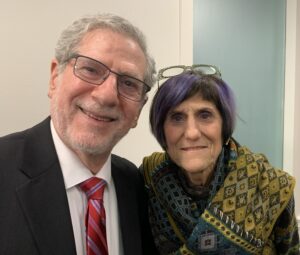
Rep. DeLauro with Joe Graedon
On February 16, 2017, I met with Representative Rosa DeLauro of Connecticut. She had reintroduced the Recall Unsafe Drugs Act that would have allowed the FDA to remove unsafe drugs from the marketplace. At that time the FDA had no authority to recall prescription medications which posed serious health risks. Recalls were entirely voluntary. If a company ignored an FDA request, there was no recourse. That made no sense to me.
I joined Representative DeLauro, David Light, Co-Founder & President of Valisure and gastroenterologist Dr. Jon Ernstoff at a press conference to promote the Recall Unsafe Drugs Act. It was finally adopted on February 4, 2022, in the America COMPETES Act of 2022.
Fast Forward to January 14, 2026 and Mental Health Funding Chaos:
Representative DeLauro is the top Democrat on the House Appropriations Committee. She and 100 other House members sent a letter to HHS Secretary Robert Kennedy, Jr., requesting reconsideration of the funding cuts. This was a bipartisan lobbying effort.
On January 15, the New York Times reported on a message from Representative DeLauro:
“These are cuts he should not have issued in the first place. This episode has only created uncertainty and confusion for families and health care providers. I hope this reversal serves as a lesson learned. Congress holds the power of the purse, and the Secretary must follow the law.”
Relief followed, but reassurance did not. This episode didn’t fix America’s mental health crisis. It exposed just how fragile the system already is, and how dangerous it is when mental health funding chaos becomes routine rather than unthinkable.
Blame Mental Illness — Then Undermine Mental Health Care
After every horrific act of mass violence, the explanation comes quickly and predictably: mental illness. It’s one way to make sense of senseless acts of terror.
But if mental illness truly lies at the heart of so much suffering and violence, our national response makes little sense. At the very moment leaders point to mental health as the problem, the systems meant to provide mental health care are left vulnerable to sudden mental health care funding cuts, confusion, and instability.
This week’s funding flip-flop made that contradiction impossible to ignore.
A Whiplash Decision About Mental Health Funding Chaos:
Termination letters went out to roughly 2,000 organizations funded through SAMHSA late Tuesday. Officials offered little explanation, no transition plan, and no guidance for patients and families who depend on these services. Programs that provide front-line health care for severe mental illness, crisis intervention, overdose prevention, peer recovery and addiction treatment faced immediate closure.
As one addiction treatment provider told NPR (January 15, 2026), the stakes were blunt and undeniable:
“If people don’t get access to treatment, they just die.”
Within 24 hours, the funding was reinstated. But the damage was not undone. Staff were demoralized. Patients were shaken. Trust was eroded in a system that already operates on the thinnest of margins.
That is the real cost of mental health funding chaos, even if the money eventually comes back.
A System Already Stretched to the Breaking Point:
Well before this week’s turmoil, America’s mental health system was in deep trouble.
There is a chronic shortage of psychiatrists, psychologists, counselors, and social workers, especially in rural and underserved communities. Many people wait months for care. Others never find it at all.
Insurance coverage often makes matters worse. Mental health parity exists on paper, but in practice:
-
Therapy visits are limited or poorly reimbursed
-
Providers find bureaucracy discouraging and may refuse to accept insurance payment
-
Patients face high out-of-pocket costs for ongoing care
As a result, medications often become the default treatment. They may not always be sufficient, but because they are the easiest to prescribe and the hardest for insurers to deny.
Drugs Alone Are Not Enough:
Psychiatric medications can be lifesaving. They can also cause serious side effects, including weight gain, metabolic and cardiovascular problems, agitation, movement disorders, emotional blunting, sexual dysfunction, and difficult withdrawal symptoms.
I spent two years working at the New Jersey Neuropsychiatric Institute in a neuropharmacology laboratory. We were trying to find better and safer medications for severe mental illness. It was a beautiful campus with lots of trees and fields. Yes, the patients were in a mental institution, but they had a bed, clean clothes, three nutritious meals daily and a staff that tried hard to keep them healthy.
Many of these safe havens have been shut down. Patients with schizophrenia and other severe mental problems are often homeless or imprisoned. The revolving door keeps spitting them out.
People with serious mental illness frequently need more than prescriptions. They need careful monitoring, supportive therapy, stable housing, transportation, and help navigating a fragmented mental health care system.
When care is reduced to pills alone, without adequate follow-up or community support, people fall through the cracks. When that happens, society is quick to blame the illness rather than the underfunded system that failed them. You may find this article relevant to the current crisis:
Have We Forsaken Mentally Ill Patients?
Why has our society failed so many mentally ill patients? Does mental illness lead to violence? Why won’t politicians commit needed resources?
When Funding Falters, the Burden Shifts Elsewhere:
When community mental health programs falter even briefly, the consequences don’t disappear. They shift:
-
To emergency rooms that are already overwhelmed
-
To jails and prisons that have become de facto psychiatric institutions
-
To families who are struggling to care for loved ones with nowhere to turn and little or no support
Restoring funding after panic sets in does not erase the harm caused by instability. A system that can be thrown into crisis literally overnight was already in deep trouble.
Mental Health Funding Chaos Makes Everything Worse:
This episode should serve as a warning.
Mental health care cannot function under constant threat, confusion, and last-minute reversals. Providers cannot plan. Patients cannot trust. Lives are put at risk, not only by illness, but by uncertainty.
If mental illness is truly a national crisis, then mental health care must be treated as essential, not a budget line that can be yanked, restored, and then yanked again.
Ending mental health funding chaos will require more than emergency reversals. It will require sustained investment, thoughtful policy, and the recognition that stability itself saves lives.
Blame is easy. Chaos is costly. And the price is paid by people who are already struggling to survive.
Final Words:
As you can tell, I am angry about the negative impact of mental health funding chaos. That’s because I have seen what happens when people with mental illness are abandoned. It is estimated that nearly 4 million Americans suffer from schizophrenia. All told, as many as 15 million people experience severe mental health issues.
Medications have not been a magic wand that solve people’s problems overnight. I saw the impact of the so-called “revolving door” policy or deinstitutionalization programs that got started in the late 1960s. When you see homeless people or those individuals shouting at invisible threats, you know we have discarded the most vulnerable.
Please share your own experience in the comment section below. What do you think about the mental health funding chaos of this week? If you think this article is important and deserves to be shared, please send it to friends and family. Thank you for your support.