
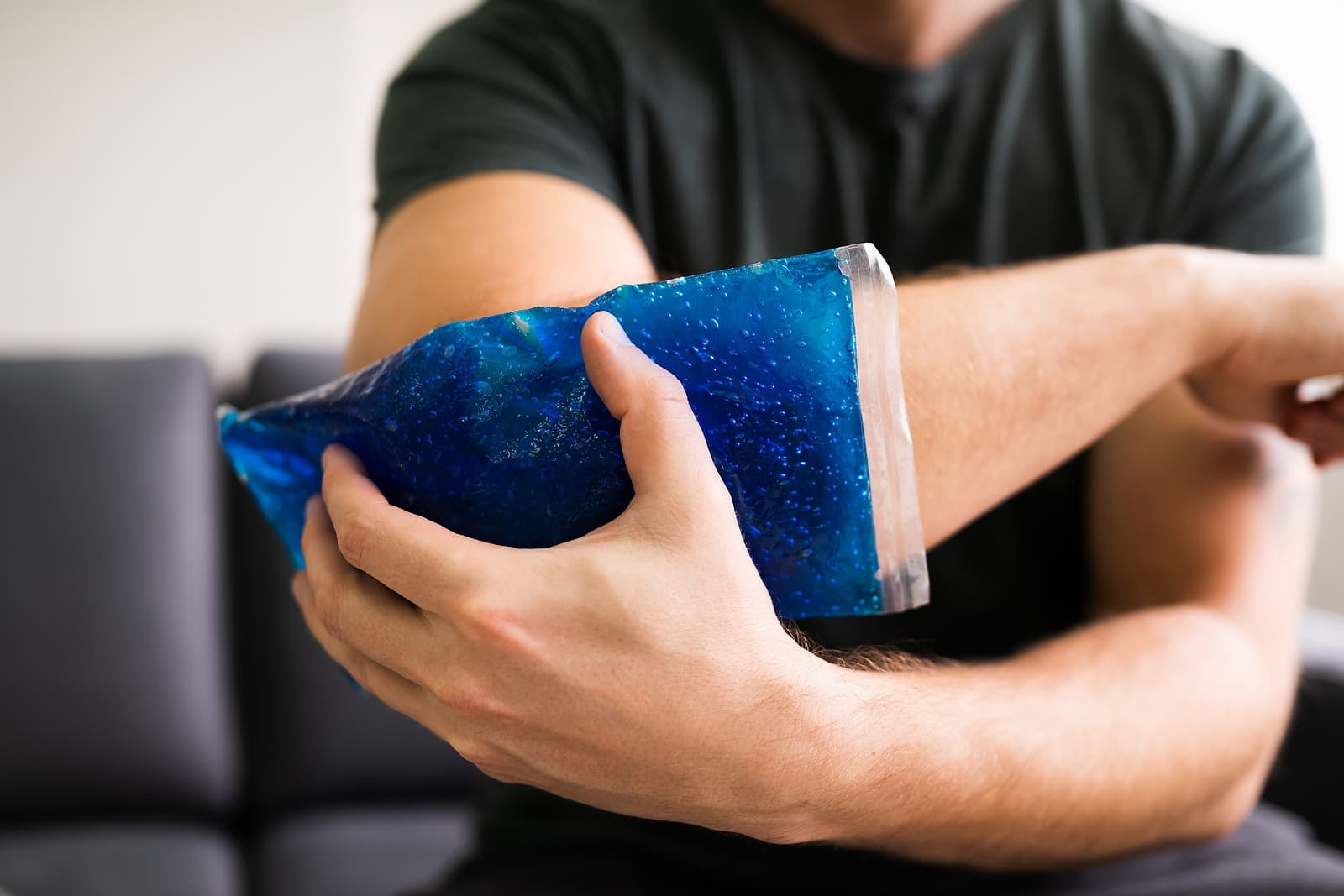
Have you ever sprained an ankle? Strained a shoulder? Developed tennis elbow, plantar fasciitis or an aching Achilles tendon? Perhaps your wrists hurt after too many hours at the keyboard. If so, there is a good chance somebody told you to rest the injury and put ice on it. For decades, that has been almost automatic advice. The acronym RICE stands for Rest, Ice, Compression and Elevation. Generations of doctors, physical therapists, coaches, parents and weekend athletes have relied on it. But injury recovery research suggests that advice may need to be reconsidered.
A New Approach to Injury Recovery!
We are honored to bring you a fascinating message from our newest People’s Pharmacy video podcast with muscle and tendon researcher Keith Baar, PhD, of the University of California, Davis. His research on injury recovery suggests that complete rest may sometimes be exactly the wrong message for injured muscles, tendons and ligaments.
And yes, that surprised us too.
Injury Recovery: Could Too Much Rest Be a Mistake?
When something hurts, our natural instinct is to protect it. We have been told:
- Don’t move it.
- Stay off it.
- Ice it.
- Take NSAIDs (ibuprofen or naproxen).
- Let it heal.
Dr. Baar explains that damaged tendons, ligaments and cartilage need protection from excessive stress, but they also respond to carefully controlled loading. In other words, the answer is not necessarily to “walk it off.” But neither is it always to stop using the injured area completely.
According to Dr. Baar, immobilization can lead surprisingly quickly to loss of muscle strength and function. Gentle movement and carefully calibrated resistance may send signals to the tissues that encourage repair.
Enough blathering from us. Let’s let Dr. Baar speak for himself:
A Different Approach to Injury Recovery
Instead of asking only, “How do we keep this from hurting?” perhaps we should also be asking, “What does this tissue need in order to rebuild?”
What About Ice?
Ice feels good after an injury because it can numb pain and reduce swelling. But swelling and inflammation are not simply nuisances. They are also part of the body’s repair response.
That does not mean people should never use ice. It does mean that automatically icing every injury, over and over again, deserves another look.
Even Dr. Gabe Mirkin, the sports medicine physician who popularized the RICE acronym decades ago, eventually backed away from the idea that rest and ice should be the universal prescription for injury.
The problem is that medical habits can have tremendous staying power. Once an idea becomes embedded in sports medicine, physical therapy and popular culture, it can take decades for newer research to catch up.
A Very Different Approach to Injury Recovery
One of the most intriguing parts of our conversation with Dr. Baar involves what he calls low-load, long-duration isometrics. That sounds complicated.
It really isn’t. An isometric exercise involves contracting a muscle without repeatedly moving the joint through a large range of motion.
Dr. Baar describes finding a level of tension that feels like “ooh” rather than “ouch.” That distinction matters.
The goal is not to grit your teeth and exercise through serious pain. Instead, the injured tissue is exposed to a carefully controlled load for a longer period of time. Dr. Baar explains exactly how this principle can be adapted to a number of familiar problems.
Sprained an Ankle? You Will Want to See This
Ankle sprains are among the most common injuries imaginable. Maybe you stepped off a curb badly. Perhaps your ankle rolled while playing tennis or pickleball. Maybe you simply tripped in the yard.
The usual reaction is immediate: get off it, ice it and keep it elevated.
In our video, Dr. Baar demonstrates another way of thinking about the injured ankle. He describes gentle rhythmic movement followed by longer isometric holds designed to stimulate the tissue without overwhelming it.
Seeing him explain the technique is far more useful than simply reading about it.
That is one reason we hope you will watch the video podcast, rather than just read this article.
Tennis Elbow, Golfer’s Elbow and Aching Tendons
You certainly do not have to play tennis to develop tennis elbow. Computer work, gardening, tools, lifting and repetitive hand movements can all irritate the tendons around the elbow.
Golfers can develop a related problem on the opposite side.
Dr. Baar discusses both tennis elbow and golfer’s elbow and explains how low-load, long-duration exercise can be used to challenge these tendons without subjecting them to the type of repeated movement that caused the problem in the first place.
He also discusses Achilles tendinopathy, another stubborn condition that can linger for months. Anyone who has ever dealt with a cranky tendon knows how frustrating that can be.
You rest it. It feels a little better. You resume your activity. It hurts again.
That cycle is precisely why this new approach to injury recovery deserves attention.
Plantar Fasciitis and Foot Pain
Plantar fasciitis can make the first few steps out of bed in the morning miserable. Some people struggle with it for months or even years. Dr. Baar explains why loading the Achilles tendon may have a beneficial effect on the plantar fascia as well.
That connection between the Achilles tendon and the bottom of the foot may surprise many people. It also illustrates an important point: the body is not a collection of completely separate parts. Muscles, tendons, fascia and joints function together.
Repetitive Stress and Carpal Tunnel Problems
Not every injury happens on a playing field. Many of us develop problems sitting in front of a computer. Typing, gripping a mouse and repeating the same movements hour after hour can stress tendons in the wrist and forearm.
During our conversation, Terry asked Dr. Baar whether the same principles that apply to athletes could also apply to ordinary repetitive-stress problems. His answer was essentially yes.
He discusses carpal tunnel syndrome and repetitive-strain problems and even demonstrates an approach using a stress ball and sustained wrist loading. For anyone who spends much of the day at a keyboard, this part of the conversation alone is worth watching.
What Elite Athletes Can Teach the Rest of Us
Some of Dr. Baar’s most dramatic examples come from professional athletes. He describes a rugby player who suffered a serious hamstring rupture that required surgical repair. The original rehabilitation plan called for a long period before meaningful loading would begin.
Dr. Baar’s team took a different approach and introduced carefully controlled loading much sooner. He also discusses rehabilitation after an Achilles tendon rupture in an NBA basketball player.
Professional athletes obviously have access to medical teams, trainers and sophisticated rehabilitation programs that most of us do not. These athletes are critical to the success of their teams.
That is precisely why these cases are so interesting. Elite sports can function as a kind of proving ground for new approaches to rehabilitation. When careers and millions of dollars are on the line, getting an athlete back safely matters enormously. The lessons researchers learn from such athletes may eventually change the way the rest of us recover from injuries.
Should You Throw Away the Ice Pack?
Please don’t misunderstand us. We are not suggesting that someone who tears a tendon, sprains an ankle or injures a shoulder should diagnose and rehabilitate the injury without professional guidance. Serious pain, swelling, weakness or inability to use a limb deserves medical attention! A fracture, torn ligament or ruptured tendon may require imaging, immobilization, surgery or specialized rehabilitation.
Nor are we telling people to exercise aggressively through pain. Quite the opposite.
What makes Dr. Baar’s research so intriguing is the idea that there may be a sweet spot between doing absolutely nothing and pushing an injured tissue too hard. That middle ground could turn out to be extremely important.
Ask Your Physical Therapist About Injury Recovery
Here is something else we would encourage. If you are seeing a physician, physical therapist, athletic trainer or other health professional for a tendon, ligament or muscle injury, consider sharing this video with them.
Medical knowledge changes. Sometimes the advice everyone learned 20 or 30 years ago needs updating.
Dr. Baar is not a social-media fitness influencer. He is a professor of molecular exercise physiology at the University of California, Davis, who studies how muscles, tendons and ligaments respond to mechanical loading and nutrition.
We found his explanation of the science fascinating, practical and surprisingly hopeful.
Watch Our New Video Podcast
Our conversation with Dr. Keith Baar is now available as a People’s Pharmacy video podcast on YouTube:
The New Science of Injury Recovery: Why Rest May Slow Healing
If you have ever suffered from a sprained ankle, tennis elbow, golfer’s elbow, an Achilles problem, plantar fasciitis, repetitive-stress pain, a shoulder injury or another stubborn soft-tissue injury, we think you will find this conversation worth your time.
Enjoyed this video podcast? Please subscribe to The People’s Pharmacy on Apple Podcasts: https://podcasts.apple.com/us/podcast…
When you subscribe, you’ll never miss our weekly conversations with leading physicians, scientists and health researchers again. And you can listen in your car, in the kitchen or wherever you have a device that can play back a podcast.
And don’t forget to join our FREE newsletter for health news and practical advice you can actually use: Subscription Options at this link. We do our best to keep you and your friends and family informed about the latest health news stories without fear or favor.
Please consider subscribing to The People’s Pharmacy on YouTube. Subscribing makes it much easier to find our newest interviews as soon as we post them. Some people prefer to listen, while others like watching our guests explain complex topics through video. We think Dr. Baar’s explanations are especially helpful in that regard.
For almost five decades, one of our guiding questions has been simple:
What does the science actually show?
Sometimes the answer confirms what doctors have been recommending for years.
And sometimes, as with RICE and injury recovery, the science tells us it may be time to rethink what everybody thought they knew. Please share your thoughts in the comment section below.
We would be grateful if you would share this post with friends and family. We guarantee that someone you care about has suffered a sprain or strain at some point. We hope that this video podcast will provide them with insights into a new way of thinking about injury recovery. We would also value your feedback in the comment section below.

&message=Injury Recovery: Why Rest and Ice May be Slowing You Down&redirect_asPath=https://www.peoplespharmacy.com/articles/injury-recovery-why-rest-and-ice-may-be-slowing-you-down)