The flu season usually begins to subside by early February. Perhaps we’ll get lucky and see that for this year as well. So far, it has been a bad flu season. The US Centers for Disease Control and Prevention show the rate of influenza-like illness above last year’s peak. Actually, last year infections peaked twice, with the second, highest, peak in mid to late February. Last year, the influenza outbreak was the worst in 15 years. So far this year, the CDC has tallied at least 15 million illnesses, 180,000 hospitalizations and 7,400 deaths from influenza.
Why Are We So Surprised About This Influenza Outbreak?
If you have been reading our newsletter for awhile, you know that we always look to Australia to predict what our flu season will look like. We do not understand why health professionals don’t follow our lead.
Why check Australia? you ask. Because the southern hemisphere is always 6 months ahead of us. As I write this, the temperature in Sydney is 80° F. Yes, it’s summer in OZ! But several months ago, Australia was in the grip of winter. It was another record-breaking flu season. And the dominant flu strain was influenza A (H3N2).
Australia’s flu season predicted what we are experiencing. There was a difference, though, from what we are now seeing in North America. The predominant strain here is also influenza A (H3N2), but with a twist. Nearly 92% of the hemagglutination assays on H3N2 type A flu this year are subclade K. That mutation did not show up until the influenza outbreak in Australia was essentially finished. It was too late to be included in this year’s influenza vaccine.
Should You Still Get Vaccinated Against the Flu?
If you have waited until mid-January for your flu shot, you might qualify as a procrastinator. Still, public health officials continue to recommend that you get vaccinated. There’s quite a bit of flu season still ahead. Even though the immunization is much less than perfect, it seems to provide some protection against the worst complications of the flu. The best data we have on that comes from a large randomized clinical trial conducted in Denmark from 2022 through 2025 (JAMA Internal Medicine, Jan. 12, 2026).
The DANFLU-2 trial compared high-dose inactivated influenza vaccine to standard-dose vaccine in more than 332,000 Danish seniors. Approximately 13% of the volunteers had diabetes, which puts them at considerably higher risk of complications. The results were clear, though not stunning. The vaccine effectiveness of the high-dose vaccine was 41.6% against flu (44.3% for older Danes with diabetes) compared to the standard dose. The high-dose shot also protected against cardiovascular complications such as heart attacks and respiratory problems like pneumonia. The greater benefit for participants with diabetes is explained by their more severe susceptibility to complications. The current standard in the US is to provide seniors with high-dose influenza vaccinations. Now we have the data demonstrating that makes a difference.
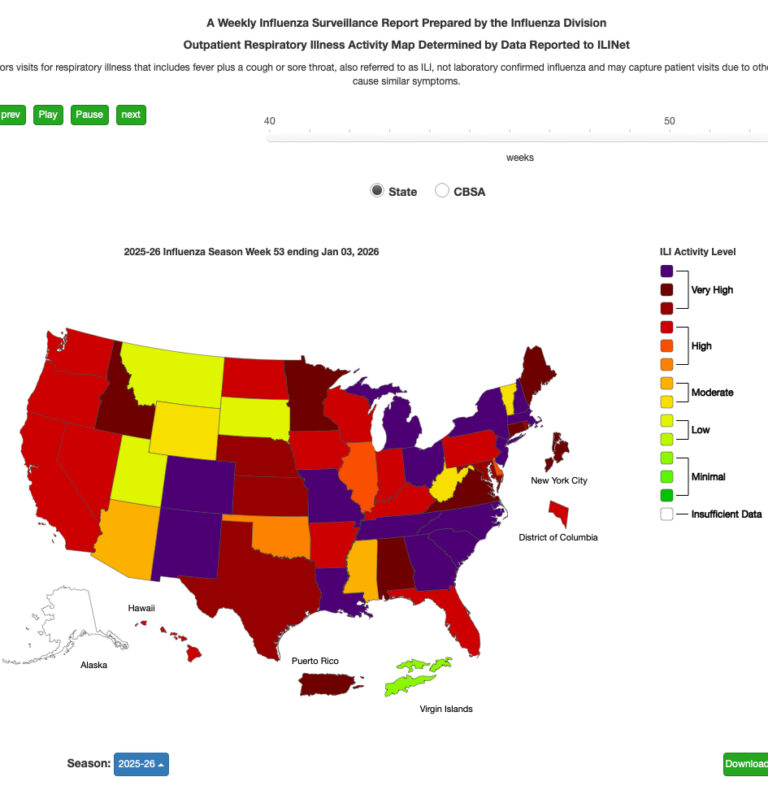
Influenza outbreak week ending 1/3/2026
Why Didn’t Flu Shots Protect Us Better Against This Influenza Outbreak?
Some experts blame this year’s bad flu season on vaccine hesitancy. For a variety of reasons, many people have become reluctant to get any vaccines. According to the CDC, vaccine rates are around 44-45% this year. Not great, but not awful either. During the last flu season vaccination rates were about 55% in kids. The trend is down.
There’s another problem with flu shots. They don’t work as well as we think most people would like. I have been tracking influenza vaccination since 2004. Some years the flu shot is 50% to 60% effective. That’s rare. Sometimes it is only 10% to 20% effective. That too is rare. On average, the flu shot is about 40% effective at preventing influenza. You can see how we arrived that that number at this link.
What Should You Know About Vaccine Effectiveness?
It is way too soon to know how effective this year’s flu shot is. But we can look to the southern hemisphere (South America) for some inkling of how the shot performed in the 2024-2025 flu season.
According to the CDC’s MMWR (Octobter 3, 2024):
Adjusted vaccine effectiveness
- 34.5% overall
- 39% among young children
- 32.2% among older adults
So, is the glass half empty or half full? Based on data from South America, the flu shot was a tad less effective than usual, but not dramatically so. If we generalize, we can say that about 1/3 of the people who got a flu shot were able to avoid hospitalization from influenza. That’s good, but it does not tell us how many people caught influenza after getting a flu shot and still felt terrible. Maybe not sick enough to go to the hospital, but still pretty awful.
One other bit of good news is that COVID-19, while still causing infections, is not at a peak. The COVID peak late last summer may have left many people with some immunity. Or perhaps the flu is crowding COVID out for now.
What to Do About This Influenza Outbreak:
How can people avoid coming down with this season subclade K type A H3N2 influenza? A new study in the journal PLoS Pathogens suggests that good ventilation could make a huge difference in viral transmission of the flu (PLOS Pathogens, Jan. 7, 2026). The investigators recruited 5 people in the early stages of an influenza infection. They all tested positive for flu and were experiencing symptoms. The researchers also recruited 11 healthy volunteers from the community. Most of them were middle-aged.
All the participants were quarantined on one floor of a Baltimore hotel. Over the course of two weeks, the two groups interacted with structured activities such as dancing, yoga and casual conversations. During some interactions, a tablet computer or a marker was passed between infected and healthy volunteers.
Although there was close contact between people with influenza and the healthy volunteers, there were no new cases of the flu. The investigators explain the lack of transmission by a couple of factors. For one, the flu patients were not coughing very much. In addition, good ventilation with rapid air mixing may also have reduced the likelihood of transmission.
One author noted,
“The air in our study room was continually mixed rapidly by a heater and dehumidifier and so the small amounts of virus in the air were diluted.”
Air quality gets short shrift too often. Florence Nightingale was the founder of modern nursing. In the middle of the 19th century, she was crusading for better ventilation in hospitals. We too have been crusading for better air quality in doctor’s offices, dentist’s offices, pharmacies, supermarkets, banks and anywhere that people gather without face masks. You can listen to our podcast on this topic at this link.
Show 1357: Revisiting Ventilation to Avoid Airborne Germs
You can read about HEPA and MERV 13 high-quality air filters at this link.
How to Stay Healthy Despite Flu Season:
You now have some sense of how you can reduce your chances of catching the flu. We spoke recently with Dr. Roger Seheult about how to strengthen your immune system for cold and flu season. We think you will find it compelling. It is Show 1457. You may also be interested in watching Dr. Seheult explain the mnemonic NEWSTART on the eight pillars of health that will help you stay healthy throughout the year. You can watch on YouTube here.
And if you would like to learn about what you can do to treat the symptoms of influenza if you are unlucky enough to catch it, here is a link to last year’s podcast with Dr. Roger Seheult. Dr. Seheult is quadruple board-certified in Internal Medicine, Pulmonary Diseases, Critical Care Medicine, and Sleep Medicine through the American Board of Internal Medicine. HIs current practice is in Beaumont, California, where he is a critical care physician, pulmonologist, and sleep physician at Optum California. Dr. Seheult describes medical topics better than anyone we know and his practical advice is quite compelling.
You may also find our eGuide to Colds, Coughs & the Flu helpful. It can be found under the Health eGuides tab at this link.
Why Has Eucalyptus Been So Popular for So Long?
The original people of Australia have known that there was something special about eucalyptus trees for centuries. Traditional healers there used the leaves of the tree to treat respiratory symptoms. Today, you will find eucalyptus in many popular over-the-counter remedies. Many cough drops contain eucalyptus oil. And grandmothers have been applying Vicks VapoRub to children’s chests for more than a century. It too contains eucalyptus oil.
We have been fascinated that people have discovered a great many uses for Vicks VapoRub. One that really captured our imagination was putting Vicks on the soles of the feet to calm a nighttime cough. You can read about this unique use at this link:
Old-Fashioned Vicks VapoRub Vindicated
Science now supports using old-fashioned Vicks VapoRub to calm coughs. It can also help treat stubborn nail fungus and so much more.
Dr. Seheult reveals a way that eucalyptus might favorably impact the immune system in this very short video clip YouTube.
Final Words:
Have you caught the flu this winter? If so, please describe how it went. What did you do to ease your symptoms? If you have so far avoided the influenza outbreak, tell us your secret. How have you managed to dodge this bullet?
And if you found this article helpful, please send it to friends and family. We would be grateful if you encourage them to sign up for our free newsletter at this link.
How To Keep Your Immune System Strong: Think of It Like An Orchestra!
To ward off infections, you need to have your immune system functioning optimally. As already mentioned, last week’s nationally syndicated People’s Pharmacy radio show and podcast (# 1447) featured one of our favorite guests, Dr. Roger Seheult. We asked him why he likes to compare our immune system to an orchestra:
You can listen to the entire radio show/podcast at this link. Show # 1457: How to Strengthen Your Immune System for Cold and Flu Season aired on January 10, 2026. We think you will find it both fascinating and practical! We hope you appreciate it and share it with friends and family.
Editors’ note: We have updated this post to reflect information from 2025-2026. The original post was published earlier.
Citations
- Nielsen AB et al, "High-Dose vs Standard-Dose Influenza Vaccine in Older Adults With Diabetes: A Secondary Analysis of the DANFLU-2 Randomized Clinical Trial." JAMA Internal Medicine, Jan. 12, 2026. DOI: 10.1001/jamainternmed.2025.728
- Zeno EE et al, "Interim Effectiveness Estimates of 2024 Southern Hemisphere Influenza Vaccines in Preventing Influenza-Associated Hospitalization — REVELAC-i Network, Five South American Countries, March–July 2024." MMWR, Oct. 3, 2024. https://pubmed.ncbi.nlm.nih.gov/39361525/
- Lai J et al, "Evaluating modes of influenza transmission (EMIT-2): Insights from lack of transmission in a controlled transmission trial with naturally infected donors." PLOS Pathogens, Jan. 7, 2026. DOI: 10.1371/journal.ppat.1013153