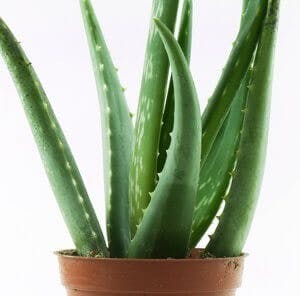
Aloe vera is a popular houseplant with medicinal potential. There are nearly five hundred species of aloe, a type of plant that originated in southern Africa, near the Cape of Good Hope.
The use of aloe goes back in history. There are pictures of aloe plants on some Egyptian temples. The Greek physician Dioscorides wrote of its benefits to heal wounds and treat hemorrhoids.
Aloes now grow throughout Africa, around the Mediterranean and the Caribbean, and in many countries in South America.
The thick, juicy leaves of aloe vera contain two distinct products that are used medicinally and that need to be distinguished to avoid confusion.
One is the thin clear gel or mucilage that oozes from the middle of a broken leaf.
The other is a bitter latex, referred to as aloe vera juice, derived from the cells just under the surface of the leaf. Their compositions and uses differ.
Active Ingredients:
Gel: mucopolysaccharides.
Latex: anthraquinone derivatives, mostly in the form of aloins, with smaller amounts of hydroxyaloins, aloe-emodin, and aloeresins.
Uses:
Gel:
The mucilage is used topically on wounds and burns to help them heal more rapidly. Some people find it useful for easing the itch of mosquito bites.
Taken internally, it is considered a general tonic. Researchers are investigating its potential against metabolic syndrome (Phytotherapy Research, Aug. 28, 2019). Unfortunately, separation of the gel from the latex for commercial preparations is often incomplete, and the gel may end up with some laxative action due to the inadvertent inclusion of aloe vera latex.
It has been recommended for burns due to radiation, but like most of its uses this one is considered incompletely proved and controversial.
There is no harm in applying fresh gel from a broken leaf to a minor cut or burn, and many people find it soothing. But studies using commercial preparations have not consistently established benefit in speeding wound healing, and there are questions about their chemical stability.
In the test tube, gels from some species of aloe have antibacterial activity. Aloe vera, however, does not appear to kill many microbes.
In animal studies, injected aloe gel improved circulation and sped wound healing. Both injection and topical application were shown independently to reduce inflammation in animals. Aloe gel blocks bradykinin, which may be how it alleviates pain.
Latex:
Aloe vera latex is a powerful laxative that irritates the intestine. We do not recommend using this product as a laxative. In the future, however, medicinal chemists may be able to harness the anthroquinones to fight certain cancers (Bioorganic & Medicinal Chemistry, Aug. 8, 2019).
Dose:
Gel:
For external application, a little dab from a broken leaf will do you.
Special Precautions:
Latex:
- Pregnant women must avoid aloe latex; use has been known to trigger abortion or premature birth.
- Nursing mothers should take this laxative only under medical supervision.
- Children must not take aloe latex.
- Women who are menstruating should not use aloe latex, as it may increase blood flow.
- Aloe latex may be very dangerous when there is an intestinal blockage and must be avoided in such cases.
- Aloe latex is not appropriate for people with intestinal inflammation such as ulcerative colitis or Crohn’s disease, and it should not be taken by people with inflamed hemorrhoids.
- People with kidney problems should avoid aloe latex.
Adverse Effects:
Latex:
The most serious difficulties encountered with aloe latex occur at higher than recommended doses or when used for more than a few days.
This laxative herb causes the loss of potassium and other minerals, which over time can result in a loss of muscle tone of the intestine and diminished effectiveness. Frequent use may cause irreversible damage.
Large doses of aloe have caused bloody diarrhea, kidney damage, and even death.
The urine may take on a reddish color after taking aloe latex. This color is harmless; however, with the possibility of kidney damage from large doses or prolonged use, any persistent color in the urine may call for medical diagnosis.
Regular ingestion of Aloe vera whole leaf extract may be carcinogenic (Journal of Environmental Science and Health. Part C, Environmental Carcinogenesis & Ecotoxicology Reviews, April 2, 2016).
Possible Interactions:
Low potassium levels can be dangerous in a person taking a heart drug like digoxin (Lanoxin).
Aloe latex might also be dangerous for anyone taking a diuretic that depletes the body of potassium (furosemide, HCTZ, etc.) because of the additive effect. It should be avoided in such situations.
Aloe latex could reduce the absorption of any pill taken around the same time because it cuts intestinal transit time so drastically.
Citations
- Shakib Z et al, "Aloe vera as an herbal medicine in the treatment of metabolic syndrome: A review." Phytotherapy Research, Aug. 28, 2019. DOI: 10.1002/ptr.6465
- Deitersen J et al, "Anthraquinones and autophagy - Three rings to rule them all?" Bioorganic & Medicinal Chemistry, Aug. 8, 2019. DOI: 10.1016/j.bmc.2019.115042
- Guo X & Mei N, "Aloe vera: A review of toxicity and adverse clinical effects." Journal of Environmental Science and Health. Part C, Environmental Carcinogenesis & Ecotoxicology Reviews, April 2, 2016. DOI: 10.1080/10590501.2016.1166826